

An audit readiness assessment tests whether your controls, evidence, and documentation would survive a real SOC 2, HIPAA, NIST, CMMC, or FedRAMP audit before you pay an auditor to find out the hard way. The right move, if you're staring down an audit date, is to start one now under a single accountable owner, internal or managed, and walk away with five things: a scope diagram, a control matrix, an owned remediation register, an automated evidence pipeline, and a completed mock audit.
TL;DR:
- Conduct the scope diagram early to clearly define systems, services, vendors, and regions involved, as scope creep remains the top cause of delays.
- Map controls to multiple frameworks simultaneously when pursuing combined compliance efforts like SOC 2 and HIPAA, saving weeks of duplicated work.
- Build a remediation register with six fields per item and assign a specific owner to ensure actionable, tracked, and timely fixes that meet actual remediation SLAs.
- Automate evidence collection from cloud logs, identity provider access reviews, and vulnerability records to provide continuous, sample-ready proof for auditors.
- Engage a single, accountable team or provider to oversee your entire readiness process, minimizing handoff friction and ensuring consistent progress toward audit goals.
Table of Contents
- What Should an Audit Readiness Assessment Cover, and When Should You Start?
- Running the Readiness Assessment: A Step-by-Step Workflow
- How Do You Build a Remediation Register That Actually Gets Used?
- Building an Evidence Pipeline Auditors Can Sample Without Chasing You
- Are Your People Ready for Interview Questions and Documentation Requests?
- Running the Mock Audit and Preparing the Handoff Package
- What to Look for in a Managed Audit Readiness Provider
- Who Owns What During a Readiness Assessment?
- Where Do Readiness Assessments Usually Go Wrong?
- What Happens After the Assessment Is Done?
- Why Accountability Beats Checklists in Audit Readiness
- Let MARFI Run Your Readiness Assessment and Own the Remediation
- Sources
What Should an Audit Readiness Assessment Cover, and When Should You Start?
Scope creep kills more audit timelines than any technical gap. Before you touch a single control, decide exactly which systems, services, and Trust Services Criteria elements are in play, and write it down. A readiness assessment that skips this step tends to expand mid-project as engineers discover "oh, that service touches customer data too."
The fix is a two-page scope diagram. It should name every product or service in scope, every cloud region involved, and every third-party subservice provider your systems depend on, since auditors treat vendor dependencies as part of your control environment, not someone else's problem.
Timing matters just as much as scope. Engaging a readiness team well in advance before your observation period starts gives you room to fix what you find. Wait until the audit window opens, and every gap becomes a live exception instead of a solved problem.
What the scope diagram needs to lock down:
- The exact systems, applications, and data flows included in the audit boundary
- Which Trust Services Criteria (security, availability, confidentiality, processing integrity, privacy) apply
- Every subservice organization and vendor whose controls feed into yours
- Cloud regions and hosting environments in scope
- A named owner for the diagram itself, so it gets updated as systems change
Running the Readiness Assessment: A Step-by-Step Workflow
A readiness assessment is not a single audit; it's four distinct passes, each building on the last. Compliance leaders who try to skip straight to "collect evidence" usually end up re-collecting it twice.
- Inventory everything. Catalog systems, data flows, and third-party dependencies before you map a single control. You cannot assess what you haven't listed.
- Map controls to your framework. Match existing controls to SOC 2's Trust Services Criteria, or to NIST SP 800-53/800-171, HIPAA's Security Rule, CMMC levels, or FedRAMP baselines, depending on which applies to your business.
- Test control design and pull representative evidence. This is where you find out whether a control that looks good on paper actually produces the artifact an auditor would ask for.
- Produce the readiness report and a prioritized remediation list. Rank gaps by risk and effort, not just by how embarrassing they are.
This sequence matters because readiness assessments exist specifically to surface control design flaws and evidence gaps before the formal engagement, and fixing something in step 4 is dramatically cheaper than fixing it during a live audit sample.
Pro Tip: Run the control mapping (step 2) against two frameworks at once if you're pursuing SOC 2 and HIPAA together. The overlap between the two is substantial, and mapping once instead of twice saves weeks.
Teams that run this workflow with an experienced partner about 90 days out from observation commonly surface 8 to 15 significant gaps worth fixing before the clock starts. Found early, those are Tuesday afternoon fixes. Found mid-audit, they're exceptions on the final report.
How Do You Build a Remediation Register That Actually Gets Used?
A gap list that nobody owns is just a document that ages badly. The step that separates a real readiness program from a checklist exercise is converting every finding into a tracked, owned line item.
Each row in the register needs six fields to function as a working document rather than a static report:
- Control reference — the specific Trust Services Criteria or framework citation
- Owner — a named person, never a team or department
- Evidence artifact — the exact file, log, or report that proves the control works
- Automation status — manual, partially automated, or fully automated
- Priority — risk-weighted, not just severity-weighted
- Due date — realistic, tied to the observation period start
Statistic Callout: Frameworks that recommend this six-field structure treat the register as the single source of truth for both the internal team and the auditor, replacing scattered spreadsheets and Slack threads with one authoritative document.
Assign SLAs that match actual remediation complexity, not wishful thinking. A patch management gap might close in a week; a vendor contract amendment could take a quarter. Set a weekly or biweekly governance cadence where owners report status against the register, and the document itself becomes the artifact your auditor reviews first. Closing the loop on automated vulnerability scanning tied to enforced SLAs produces most of the remediation evidence auditors actually want to see.
Building an Evidence Pipeline Auditors Can Sample Without Chasing You
Manual evidence collection is where readiness programs quietly die. If someone has to remember to screenshot the access review every month, eventually someone forgets, and that gap shows up as a sampling exception.
The artifacts auditors expect are fairly consistent across frameworks:
- Cloud audit logs (CloudTrail, Azure Monitor, GCP Cloud Audit Logs)
- Identity provider access logs and periodic access review records
- Patch management and vulnerability remediation records
- CI/CD pipeline traces showing change management controls
- Training completion and phishing simulation records
- SOC reports from critical vendors and subservice organizations
Automation is what turns this from a monthly scramble into a background process. Piping your identity provider and cloud audit logs into a tamper-evident SIEM or compliance platform means access reviews and event evidence require no manual exports at all. Connect your ticketing system to the same pipeline, and remediation evidence generates itself as work gets done.
Pro Tip: Set log retention to cover your full observation period plus 90 days. Auditors sample across the entire window, and a retention policy that only covers "the last 30 days" creates a gap you'll discover at the worst possible time.
Auditors increasingly expect continuous evidence across the full audit window rather than a point-in-time snapshot, and automated pipelines are what make that standard achievable without adding headcount.
Are Your People Ready for Interview Questions and Documentation Requests?
Technical controls get most of the attention, but workforce readiness is one of the most common weak points auditors find. An engineer who can't articulate why a control exists during an interview raises more suspicion than a minor technical gap.
Before the audit window opens, confirm:
- Every role likely to face an auditor interview knows what artifacts they'll be asked to produce
- Training completion records and phishing simulation results are current and exportable
- Policies are version controlled, mapped to the controls they support, and dated
- Evidence folders are organized by control reference, not scattered across shared drives
Compliance has to be operationalized into routine work, not assembled the week before the audit starts.
Running the Mock Audit and Preparing the Handoff Package
A mock audit is the closest thing to a dress rehearsal you'll get, and it should feel uncomfortable in the same places a real audit would. Done right, it samples evidence across your observation window exactly as an auditor would, then produces a management letter mapping each weakness to its Trust Services Criterion.
- Sample evidence across the full observation period, not just recent weeks.
- Interview the same roles a real auditor would target.
- Document every finding with a severity rating and a remediation owner.
- Set a hard remediation deadline, typically 30 to 60 days before the real engagement.
Gaps found at this 90-day mock stage are almost always fixable in time. The final handoff package for your CPA or auditor should include the control matrix, organized evidence folders mapped to each control, the scope diagram, and the remediation register showing closed and in-progress items side by side.
What to Look for in a Managed Audit Readiness Provider
Not every compliance vendor operates the same way, and the differences show up fast once remediation deadlines start slipping. Evaluate a provider against a short list of concrete capabilities rather than a sales pitch.
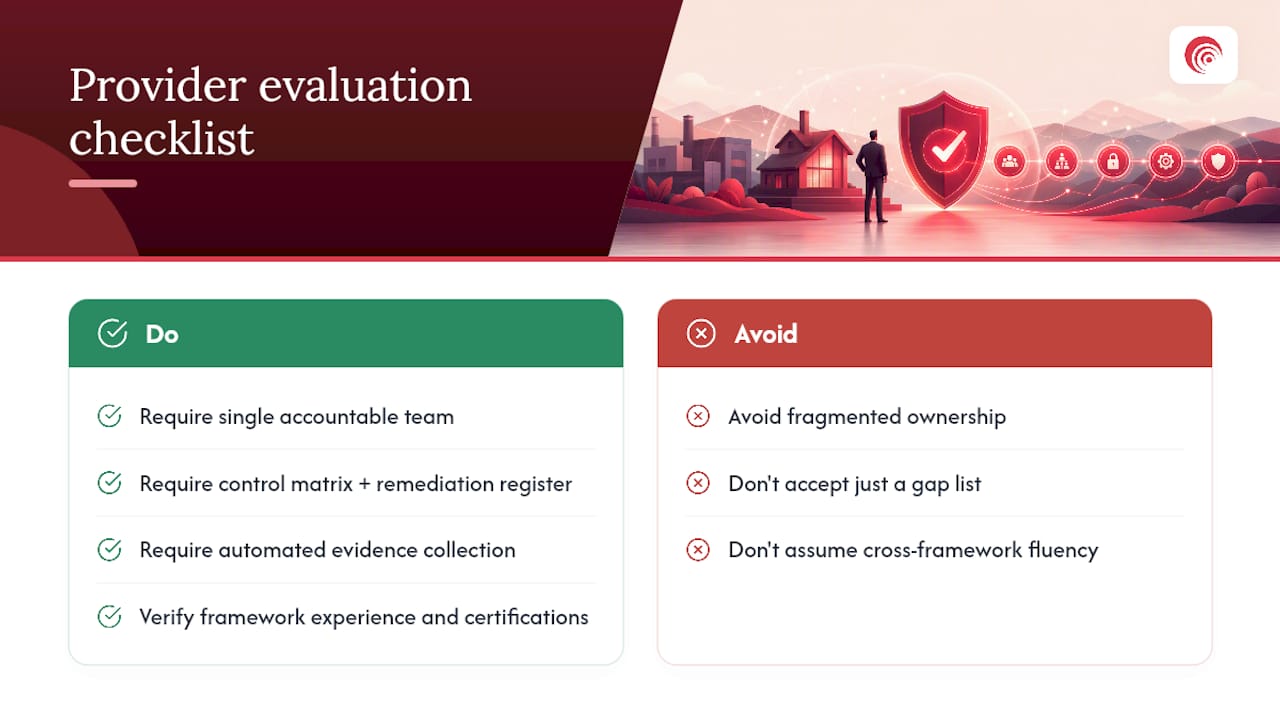
Ask whether the provider assigns a single accountable team across the engagement, or hands you off between a sales rep, an implementation contractor, and a support queue. Fragmented ownership is where remediation items stall, because nobody feels responsible for the item that falls between two vendors' scopes.
Ask what they actually deliver, not just what they promise. A control matrix and an owned remediation register are table stakes; a provider should also show you how they automate evidence collection rather than just consulting on what to collect manually. Ask for specifics on integration with your identity provider, cloud logging, and ticketing system, since that's where most of the manual burden actually lives.
Ask about track record with your specific framework. A provider fluent in SOC 2 isn't automatically fluent in FedRAMP's continuous monitoring requirements or CMMC's assessment levels. Certifications matter here too. A provider that has been through SOC 2 Type II certification themselves understands the auditor's perspective from both sides of the table, not just the client side.
Finally, ask how they handle the mock audit and the handoff to your actual CPA or auditor. A provider that stops at "here's your gap list" leaves you to run the dress rehearsal yourself.
Who Owns What During a Readiness Assessment?
Confusion about ownership is the fastest way to stall a readiness program. Every engagement needs clear lines between who decides scope, who fixes gaps, and who signs off on evidence.
| Role | Primary responsibility | Typical artifact owned |
|---|---|---|
| Compliance lead / CISO | Owns scope decisions and framework selection | Scope diagram, control matrix |
| System/control owners | Fix assigned gaps within SLA | Remediation register line items |
| IT operations | Maintain patch, access, and change management evidence | Log exports, ticketing records |
| HR or people ops | Maintain training and onboarding records | Training completion logs |
| Managed readiness partner | Coordinates the assessment, automates evidence, runs the mock audit | Readiness report, mock audit findings |
| External CPA/auditor | Validates evidence and issues the final report | Audit report, management letter |
The compliance lead sets direction, but the control owners are where remediation actually gets done. A readiness program that puts every fix on the CISO's desk will move at the speed of one overloaded person instead of a distributed team working in parallel.
Where Do Readiness Assessments Usually Go Wrong?
The same handful of mistakes show up across nearly every stalled readiness program, and most are avoidable with a bit of foresight.
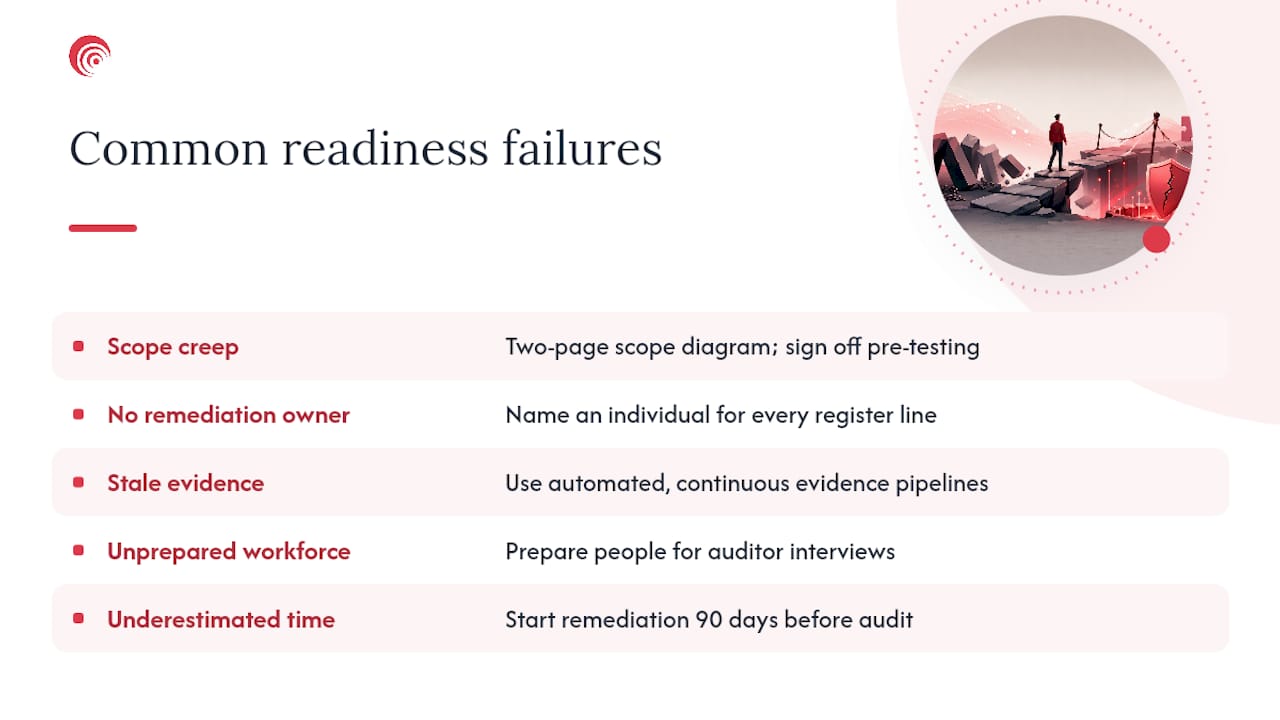
Scope creep mid-project. Someone discovers a system that should have been in scope from day one, and the assessment restarts its inventory phase weeks in. The fix is the two-page scope diagram, reviewed and signed off before any control testing begins.
Remediation items with no real owner. A gap assigned to "the engineering team" never closes on schedule, because no individual feels accountable. Assign a named person to every line in the register, not a department.
Evidence collected once, then stale by audit time. Screenshots taken during the readiness phase don't hold up months later when the observation period actually starts. This is the strongest argument for automated, continuous evidence pipelines over manual exports.
Workforce readiness treated as an afterthought. Technical controls get fixed, but nobody preps the people who'll actually sit in auditor interviews, and that gap shows up as a finding nobody expected.
Underestimating remediation time. Teams that start 30 days out instead of 90 discover gaps they simply don't have time to fix properly, and end up negotiating exceptions instead of closing them.
What Happens After the Assessment Is Done?
Passing the readiness assessment isn't the finish line. Controls drift, employees change roles, and vendors update their own compliance posture, all of which can quietly reopen gaps you thought were closed.
Set a continuous monitoring cadence, not a once-a-year fire drill. Keep the remediation register active year round, reviewing it on the same cadence you used during readiness prep, even after the audit report is signed. Re-run access reviews, patch audits, and training completion checks on a fixed schedule rather than waiting for next year's audit to surface what slipped.
Revisit the scope diagram whenever you add a new vendor, launch a new product, or expand into a new cloud region, since scope drift between audits is exactly what turns a routine renewal into a surprise. Treat your evidence pipeline as permanent infrastructure, not a project that ends when the auditor leaves.
Why Accountability Beats Checklists in Audit Readiness
Most readiness advice treats the process as a documentation exercise: fill in the matrix, collect the logs, done. That misses what actually determines whether an audit goes smoothly. The variable that matters most is whether one team owns the outcome end to end, or whether responsibility is split across a patchwork of vendors who each own a slice and none of the result.
A cohesive team that handles your managed IT, your security monitoring, and your compliance evidence under one roof doesn't lose weeks to handoff friction between separate providers. Marfi's approach reflects that logic directly: a single accountable team running 24/7 security operations, holding SOC 2 Type II certification itself, and managing the same evidence pipeline it recommends to clients. That's not a minor operational detail. It's the difference between a remediation register that gets worked every week and one that gets rediscovered the week before the audit.
— Danny
Let MARFI Run Your Readiness Assessment and Own the Remediation
Marfi is the accountable alternative to juggling separate compliance consultants, IT vendors, and security monitoring providers for the same audit. Instead of coordinating three contracts and hoping they talk to each other, you get one team running your evidence pipeline, your 24/7 security operations center, and your remediation register under a single agreement.
That team brings SOC 2 Type II certification of its own, along with hands on experience mapping controls across SOC 2, HIPAA, NIST, CMMC, and FedRAMP for companies that can't afford a failed audit. Evidence collection runs through the same monitoring infrastructure Marfi uses for its managed cybersecurity operations, so logs, access reviews, and remediation status stay current without a manual scramble before observation starts.
If your next audit is on the calendar, or you suspect it should be, the practical next step is a readiness assessment scoped to your framework and timeline. Reach out to Marfi's managed IT and compliance team to get a scope diagram and control matrix started before your remediation window gets any shorter.
Sources
- SOC 2 Readiness Assessment: How to Prepare for a Successful Audit | Clark Nuber PS
- SOC 2 Readiness Assessment: 7-Step Framework (2026)
- Preparing Teams for NIST, HIPAA, PCI & SOC 2 Audits
- soc-2-audit-checklist