

Endpoint detection and response (EDR) continuously records endpoint telemetry to detect, investigate, and enable automated or manual response, giving security teams the attack timeline and containment tools they need to cut dwell time. Every laptop, server, and workload becomes a sensor instead of a blind spot. When mapped against a framework like MITRE ATT&CK and paired with an incident process aligned to NIST SP 800-61r3, EDR turns a vague "something looks wrong" into a documented sequence of events an analyst can act on in minutes, not days.
That speed matters because attackers rarely announce themselves. They live in normal-looking process activity until the moment they don't.
- Records process, file, registry, and network activity across endpoints in real time
- Detects malicious behavior using analytics, machine learning, and known indicators
- Reconstructs the full attack timeline for investigation and forensic evidence
- Enables isolation, process termination, or rollback before an incident spreads
Key Takeaways
Effective endpoint detection and response depends on telemetry depth, fast detection-to-response workflows, and either a staffed SOC or a managed provider to operate it around the clock.
| Point | Details |
|---|---|
| EDR fills the gap after prevention fails | Assume some attacks bypass EPP, and use EDR's telemetry and response tools to catch what gets through. |
| Telemetry depth drives detection quality | Process, memory, registry, and network telemetry together reveal attacks that partial visibility misses. |
| Test with realistic POC scenarios | Run live ransomware simulation and real telemetry replay, not vendor demo scripts, before signing. |
| Combine EDR with NDR or XDR for full visibility | Network and cross-signal correlation close blind spots single-endpoint telemetry can't cover. |
| Managed operations close the staffing gap | Marfi's 24/7 SOC and SOC 2 Type II controls operationalize EDR for regulated companies without an in-house build. |
Table of Contents
- What Is Endpoint Detection and Response, and What Does It Cover?
- How Does EDR Actually Detect and Respond to Threats?
- Which EDR Features Actually Matter for Enterprise Security?
- EDR vs. Antivirus, XDR, NDR, and MDR: What's the Difference?
- What Real Attacks Does EDR Help You Stop?
- How Do You Evaluate and Choose the Right EDR Platform?
- What Operational Factors Determine Whether EDR Succeeds?
- What Does an EDR Rollout Actually Cost and How Long Does It Take?
- How Marfi Approaches EDR for Regulated Organizations
- Get 24/7 EDR Operations Without Building a SOC From Scratch
- Sources
What Is Endpoint Detection and Response, and What Does It Cover?
EDR is software (usually a lightweight agent plus a cloud or on-premises analytics back end) that monitors endpoint activity continuously and gives analysts the tools to investigate and respond to threats. "Endpoint" covers more ground than most people assume: laptops, desktops, physical and virtual servers, and increasingly containers and workloads running in cloud environments. IoT coverage remains limited, since many devices can't run a traditional agent, which is why network-based visibility often fills that gap.
The agent-based versus agentless question shapes almost every deployment decision that follows.
- Agent-based EDR installs software on each device, giving deep visibility into memory, kernel-level events, and process behavior, but it requires ongoing lifecycle management and can affect device performance if poorly tuned.
- Agentless approaches pull telemetry from existing infrastructure (cloud APIs, network taps) with far less deployment friction, at the cost of reduced granularity on process-level behavior.
- Most production environments run agent-based EDR on managed endpoints and lean on agentless or network telemetry for the devices that can't take an agent.
EDR sits inside a larger stack, not above it. Endpoint protection platforms (EPP) block known threats before execution; EDR catches what gets past that layer and gives you the tools to chase it down. Extended detection and response (XDR) then pulls EDR telemetry together with email, identity, and cloud signals into one correlated view.
How Does EDR Actually Detect and Respond to Threats?
EDR's value comes down to what it collects and how fast it turns that data into a decision. The telemetry layer is the foundation, and skimping on it is the single most common reason EDR deployments underperform in production.
- Process telemetry captures every executable launch, parent/child relationships, and command-line arguments, which is where most attack chains first show up.
- File system events track creation, modification, and deletion, which is critical for catching ransomware encryption behavior early.
- Registry monitoring (on Windows environments) reveals persistence mechanisms attackers use to survive a reboot.
- Memory and kernel-level telemetry exposes fileless attacks and process injection techniques that never touch disk.
- Network connection data from the endpoint itself shows command-and-control beaconing and lateral movement attempts.
Detection logic layers on top of that telemetry in three main ways: signature and indicator-of-compromise (IOC) matching for known threats, behavioral analytics that flag anomalous sequences (a Word document spawning PowerShell, for instance), and machine learning models trained to catch variations of known attack patterns. Vendor and technical explainers describe this combination of continuous collection plus analytics as the core of modern endpoint security, and mature platforms map detections directly to MITRE ATT&CK technique IDs so analysts can see exactly where in the kill chain an alert falls.
Investigation tooling is where a good EDR platform separates itself from a mediocre one. Process tree visualizations let an analyst trace an alert back to its root cause in seconds rather than piecing together log entries by hand. Attack timeline reconstruction stitches telemetry into a chronological story: initial access, execution, persistence, lateral movement. Forensic artifacts (memory dumps, file hashes, network captures) get preserved for compliance reporting or law enforcement handoff.
Response actions split into automated and manual tiers. Automated isolation quarantines a compromised host from the network the instant a high-confidence detection fires. Process kill terminates malicious execution. File quarantine stops further damage. Rollback, where supported, reverts file changes caused by ransomware encryption, though rollback has limits: it typically covers file system changes, not registry corruption or data already exfiltrated.
Pro Tip: Test rollback capability against a live ransomware simulation during your proof of concept, not a vendor demo video. Rollback that works on a clean lab machine often behaves differently against real encryption behavior at scale.
Which EDR Features Actually Matter for Enterprise Security?
Feature checklists all look similar on a spec sheet. The categories below are where real operational differences show up.
- Telemetry depth versus agent footprint. Deeper visibility (kernel-level, memory-resident) generally means a heavier agent. Lightweight agents sacrifice some visibility for lower CPU and memory overhead, a real trade-off on resource-constrained endpoints.
- Detection engineering maturity. Can your team tune detection rules, suppress noisy alerts, and write custom behavioral logic, or are you stuck with whatever the vendor ships?
- Automation and orchestration. Auto-isolation, auto-rollback, and SOAR playbook triggers determine how much manual analyst time gets consumed per incident.
- Threat hunting support. Ad-hoc query languages and historical search let analysts proactively hunt for indicators that didn't trigger an alert.
- Forensics and retention. How long is raw telemetry stored, and can analysts export it for compliance audits or legal discovery?
- Integration depth. SIEM, SOAR, identity providers, email security, and cloud telemetry sources all need to feed into (or pull from) the EDR platform without custom engineering work.
Analyst evaluations from firms like Gartner consistently flag telemetry breadth and detection quality as the two factors that separate enterprise-grade platforms from consumer-adjacent tools wearing enterprise branding. Retention policy deserves specific attention here: a platform that only keeps 30 days of telemetry can't support an investigation into an attacker who established a foothold three months earlier, a scenario that shows up constantly in real incident response engagements.
EDR vs. Antivirus, XDR, NDR, and MDR: What's the Difference?
Legacy antivirus works from a static list of known bad signatures and blocks execution before it happens. Modern EPP expanded that to behavioral prevention, but both stop at the "block or allow" decision. EDR picks up where prevention fails, assuming something will eventually get through, and gives you the tools to detect and respond to it.
- XDR correlates EDR telemetry with email, identity, and cloud signals into a single detection surface. It earns its cost when your attack surface spans multiple clouds and SaaS platforms that a single-endpoint view can't cover.
- NDR (network detection and response) watches traffic patterns across the wire, catching lateral movement and command-and-control activity that an endpoint agent might miss entirely, especially on unmanaged or IoT devices.
- Corelight's comparison of these categories describes EDR, NDR, and centralized analytics together as forming a SOC visibility triad that closes blind spots no single tool covers alone.
- MDR (managed detection and response) isn't a technology category so much as an operational model: a third party staffs the SOC, tunes detections, and triages alerts on your behalf, using EDR (often paired with NDR) as the underlying data source.
The decision isn't EDR versus MDR. It's whether you build 24/7 monitoring capability in-house or buy it as a managed outcome.
What Real Attacks Does EDR Help You Stop?
Abstract capabilities become concrete once you map them to actual incidents.
- Ransomware. EDR detects the mass file encryption behavior pattern early, isolates the host automatically, and in supported cases rolls back encrypted files before the attack spreads laterally to shared drives.
- Credential theft and lateral movement. When an attacker dumps credentials from memory and pivots to a second machine, process telemetry and network connection data expose the movement path, letting analysts contain it before domain admin is compromised.
- Stealthy, low-noise intrusions. Advanced persistent threat behavior often avoids triggering automated alerts entirely. Threat hunters query historical telemetry for subtle indicators, an unusual scheduled task, an odd parent process, that automated detection missed.
- Compliance and post-incident reporting. Retained telemetry and reconstructed timelines give auditors and regulators the forensic evidence needed to demonstrate an incident was contained and scoped correctly, a requirement that shows up repeatedly in frameworks like HIPAA and CMMC.
How Do You Evaluate and Choose the Right EDR Platform?
A vendor's feature list tells you almost nothing about how the platform performs under real conditions. A structured proof of concept does.
- Rank your evaluation criteria before you start. Detection quality and telemetry breadth should outweigh price and interface polish; a cheap platform that misses lateral movement costs far more later.
- Inject realistic telemetry, not synthetic test files. Buyer guides recommend replaying actual attack telemetry rather than relying on canned vendor demo scenarios that are tuned to make every platform look good.
- Run a realistic ransomware simulation test. Watch how fast detection fires, whether isolation happens automatically, and whether rollback actually restores encrypted files.
- Measure query performance under load. A threat hunting query that takes ten seconds on a demo tenant might take ten minutes against your real telemetry volume. Test it at scale.
- Track mean time to detect and mean time to respond during the pilot. These two numbers, not the vendor's marketing claims, tell you what your SOC will actually experience.
- Ask about hidden telemetry costs. Some platforms charge separately for extended retention or high-volume ingestion, a cost that only surfaces after signing.
- Push on forensic access. If analysts can't export raw telemetry for a compliance audit or legal hold, that's a structural limitation, not a minor inconvenience.
Red flags worth walking away from: frequent false positives that train analysts to ignore alerts, vague answers about telemetry retention limits, and agents that noticeably degrade endpoint performance during the pilot.
Pro Tip: Ask every finalist vendor the same question: "Show me a detection you missed in the last 90 days and what you changed afterward." A vendor with a real answer has a mature detection engineering practice. A vendor with no answer is telling you something too.
What Operational Factors Determine Whether EDR Succeeds?
Buying the platform is the easy part. Running it well is where most programs stall.
- Staffing a 24/7 SOC in-house requires multiple analysts across shifts, plus ongoing training to keep pace with new attack techniques, an investment many mid-sized organizations can't sustain alone.
- Telemetry volume grows fast, and retention policy decisions directly affect both storage cost and how far back an investigation can reach.
- Alert triage needs a defined workflow, ideally with SOAR integration, so analysts spend time on genuine threats instead of manually clearing noise.
- Agent lifecycle management (deployment, patching, compatibility testing against new OS versions) is an ongoing operational task, not a one-time install.
What Does an EDR Rollout Actually Cost and How Long Does It Take?
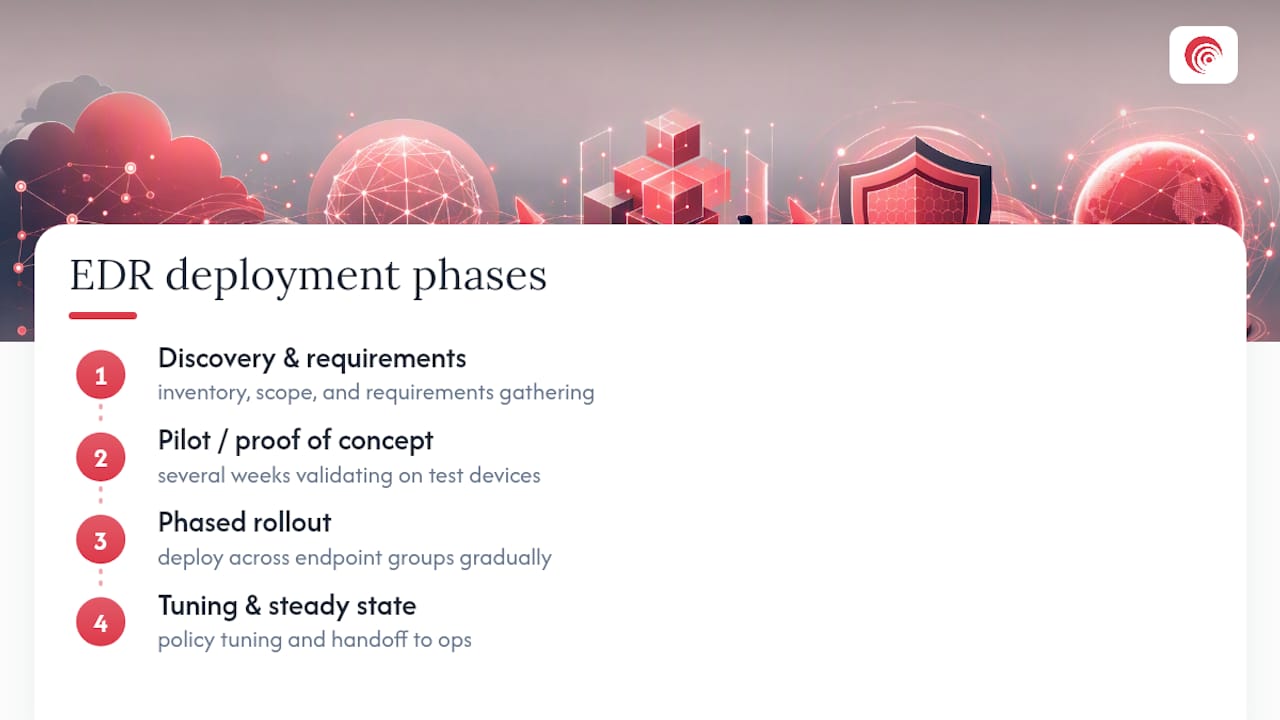
Deployment typically moves through four phases: discovery and requirements gathering, a pilot or proof of concept running several weeks, phased rollout across endpoint groups over an extended period, then a tuning period before reaching steady state operations.
Cost drivers cluster around a few predictable categories: per-endpoint licensing, telemetry storage and retention tier, SOC staffing or managed detection and response fees if you're not building in-house, professional services for initial deployment, and integration work connecting EDR to your SIEM and SOAR tooling.
Before requesting budget approval, confirm you can answer: What's the per-endpoint cost at your actual device count? What's included in the base tier versus billed as an add-on? Who staffs alert triage after the pilot ends? Those three questions catch most of the surprises that derail EDR budgets mid-year.
How Marfi Approaches EDR for Regulated Organizations
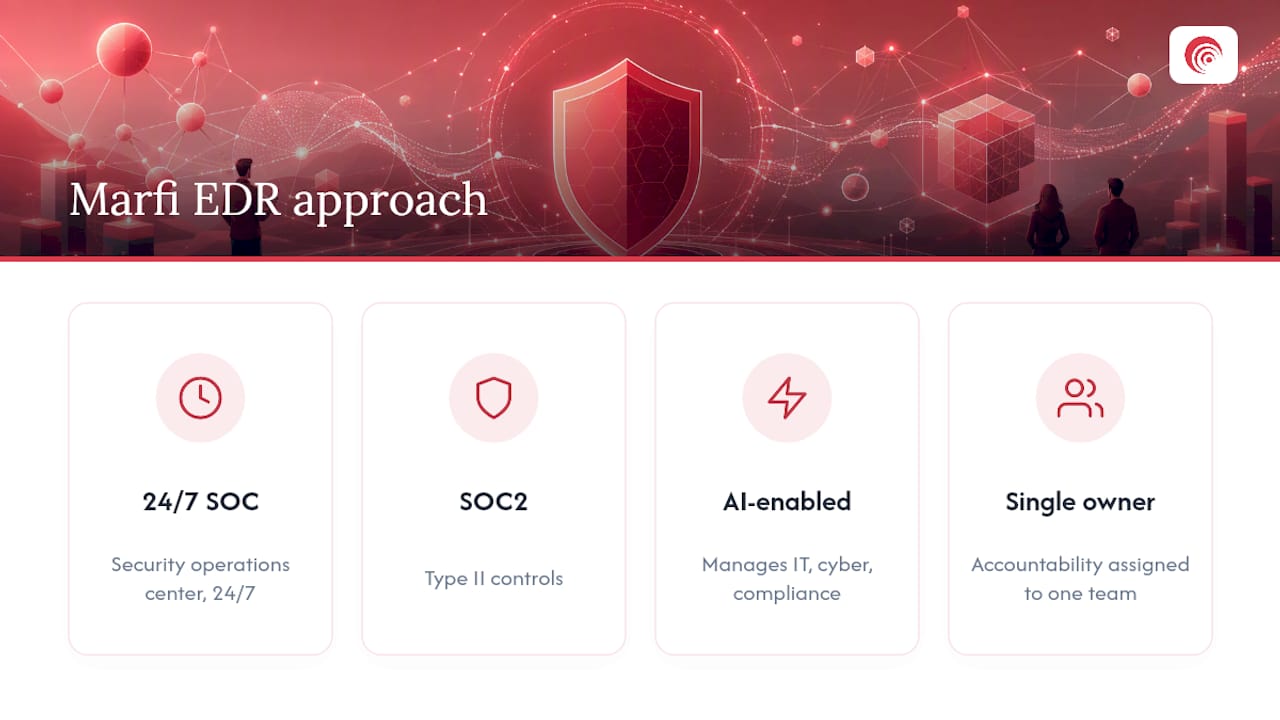
Marfi operates as a US-based, AI-enabled provider managing IT, cybersecurity, compliance, and secure AI operations for companies in regulated industries. Regulated environments don't have room for detection gaps discovered after the fact.
That's why Marfi runs a 24/7 security operations center built around SOC 2 Type II controls, operationalizing EDR telemetry into verified outcomes rather than raw alert volume a stretched internal team has to interpret alone. Accountability sits with one team rather than being scattered across vendors.
— Danny
Get 24/7 EDR Operations Without Building a SOC From Scratch
If you've read this far, you already know the hard part of EDR isn't buying the platform, it's running it well every hour of every day. Marfi gives regulated companies a single accountable team for managed IT, cybersecurity, and compliance instead of stitching together separate vendors for endpoint tooling, SOC staffing, and audit prep.

That means your EDR telemetry gets watched by a real 24/7 security operations center staffed under SOC 2 Type II controls, with the same team handling compliance evidence for frameworks like HIPAA, CMMC, or NIST SP 800-171 when auditors come calling. For companies already navigating CMMC or DFARS requirements, that alignment between security operations and compliance documentation removes a step most organizations handle as two disconnected projects. If you're evaluating whether to build an in-house SOC or bring in a managed partner, start with a conversation about your current managed IT and security setup and see where the gaps actually are.
Sources
- NIST SP 800-61r3 — Computer Security Incident Handling Guide
- What Is Endpoint Security? EPP, EDR, and XDR Explained - Palo Alto Networks
- Gartner market and vendor evaluation