

Successful ISO 27001 implementation turns information security from a set of scattered habits into a documented, auditable management system, and it starts with one move: getting top management to sign a project mandate and naming an ISMS lead. Budget 90 days for a tight transition project or 3 to 9 months for a full first-time build, and expect total first-year costs anywhere from $10,000 to $50,000 depending on scope and how much you automate.
TL;DR:
- Keeping scope narrow, well-justified, and using sampling rules can significantly reduce audit costs and implementation complexity for multi-site organizations.
- Prioritizing risk assessment and control implementation before document drafting prevents costly rework and timeline overruns during certification.
- Automating evidence generation through logging, IAM, and monitoring tools can streamline audits and lower ongoing maintenance costs.
- Starting the certification process with a firm internal pre-audit and booking the certification audit date early helps avoid delays and surprises during Stage 2.
- Ongoing compliance requires regular internal audits, continuous metric collection, and management reviews to maintain audit readiness between surveillance cycles.
Table of Contents
- What Does an ISO 27001 Implementation Checklist Look Like?
- How Do You Structure the Project for Governance and Buy-In?
- How Do You Define Scope Without Overextending the Project?
- How Do You Run the Risk Assessment and Build the SoA?
- How Do You Select and Map Annex A Controls?
- What Documentation Do Auditors Actually Expect to See?
- Which Technical Controls Give You the Clearest Audit Evidence?
- What Should You Check Before Inviting a Certification Body?
- How Much Does Certification Cost, and What Do Stage 1 and Stage 2 Actually Involve?
- How Do You Keep the ISMS Running After Certification?
- A Managed Approach to ISO 27001 Implementation
- Do Employees Really Need Security Training for ISO 27001?
- The Real Bottleneck Isn't the Standard, It's Sequencing
- Get Managed Support for Your ISO 27001 Implementation
- Where to Learn More
- Sources
What Does an ISO 27001 Implementation Checklist Look Like?
Every certified ISMS follows the same skeleton, even though the details shift by industry and headcount. The steps below map to ISO/IEC 27001:2022 clauses 4 through 10, so you can hand this list to an auditor and show exactly where each requirement gets satisfied.
- Secure the project mandate (Clause 5). Top management signs off on scope, objectives, and resourcing. Owner: CEO or CISO. Duration: 1 to 2 weeks. Pitfall: a mandate with no budget line attached stalls the project by month three.
- Build the implementation plan. Turn the mandate into a project charter with milestones, a RACI chart, and a risk-based approach mapped to clauses 4 to 10, an approach GRC Solutions recommends for keeping scope honest from day one. Owner: project manager. Duration: 2 to 3 weeks.
- Define scope and context (Clause 4). Document interested parties, boundaries, and internal/external issues. Owner: ISMS lead. Duration: 2 weeks. Pitfall: scoping the whole company when only one product line touches customer data.
- Stand up the ISMS framework. Draft the information security policy, appoint process owners, and set objectives. Owner: ISMS lead with steering committee input. Duration: 3 to 4 weeks.
- Run the risk assessment and build the Statement of Applicability (Clause 6). Score assets against your risk criteria, decide which Annex A controls apply, and justify every inclusion and exclusion. Owner: ISMS lead with department heads. Duration: 4 to 6 weeks. Pitfall: a SoA with generic justifications like "applicable" and nothing else.
- Implement controls (Clause 8). Roll out the technical, organizational, physical, and people controls the SoA calls for. Owner: IT, HR, and facilities working together. Duration: 6 to 12 weeks, the longest phase in most projects.
- Produce required documentation (Clause 7). Policies, procedures, risk records, and training logs all need to exist and be controlled. Owner: ISMS lead. Duration: runs in parallel with control implementation.
- Run an internal audit (Clause 9). An independent party (internal or contracted) tests whether the ISMS actually works. Owner: internal auditor, never the ISMS lead. Duration: 1 to 2 weeks.
- Hold a management review (Clause 9). Leadership reviews audit results, incidents, and metrics, then commits resources to close gaps. Owner: top management. Duration: half a day, once findings are compiled.
- Complete certification audits (Stage 1 and Stage 2). A certification body checks documentation, then operational evidence. Owner: ISMS lead coordinates; the whole organization participates. Duration: Stage 1 and Stage 2 typically run weeks apart.
- Maintain through surveillance and recertification. Annual surveillance audits and a full recertification every three years keep the certificate valid.
The most common pitfall across all eleven steps isn't a missing control. It's sequencing: teams start implementing controls before the risk assessment is finished, which means half the work gets redone once the Statement of Applicability is actually approved.
How Do You Structure the Project for Governance and Buy-In?
An ISO 27001 project without a named owner and a steering committee tends to drift, because information security touches every department but belongs to none of them by default. The mandate document should state the objective plainly: "Achieve ISO/IEC 27001:2022 certification for [defined scope] within [timeframe] to support [customer trust / procurement / risk reduction] goals," with a named executive sponsor attached.
Roles worth defining before you write a single policy:
- ISMS owner — usually the CISO or a senior IT/security manager, accountable for the whole system.
- Project manager — runs the timeline, budget, and cross-team coordination; can be the same person as the ISMS owner in smaller organizations.
- Process owners — department heads who own the controls that touch their function (HR owns onboarding/offboarding controls, IT owns access management).
- Internal auditor — must be independent of the areas they audit; often a contracted role in organizations under 200 employees.
- Steering committee — meets monthly to clear blockers and approve resourcing decisions.
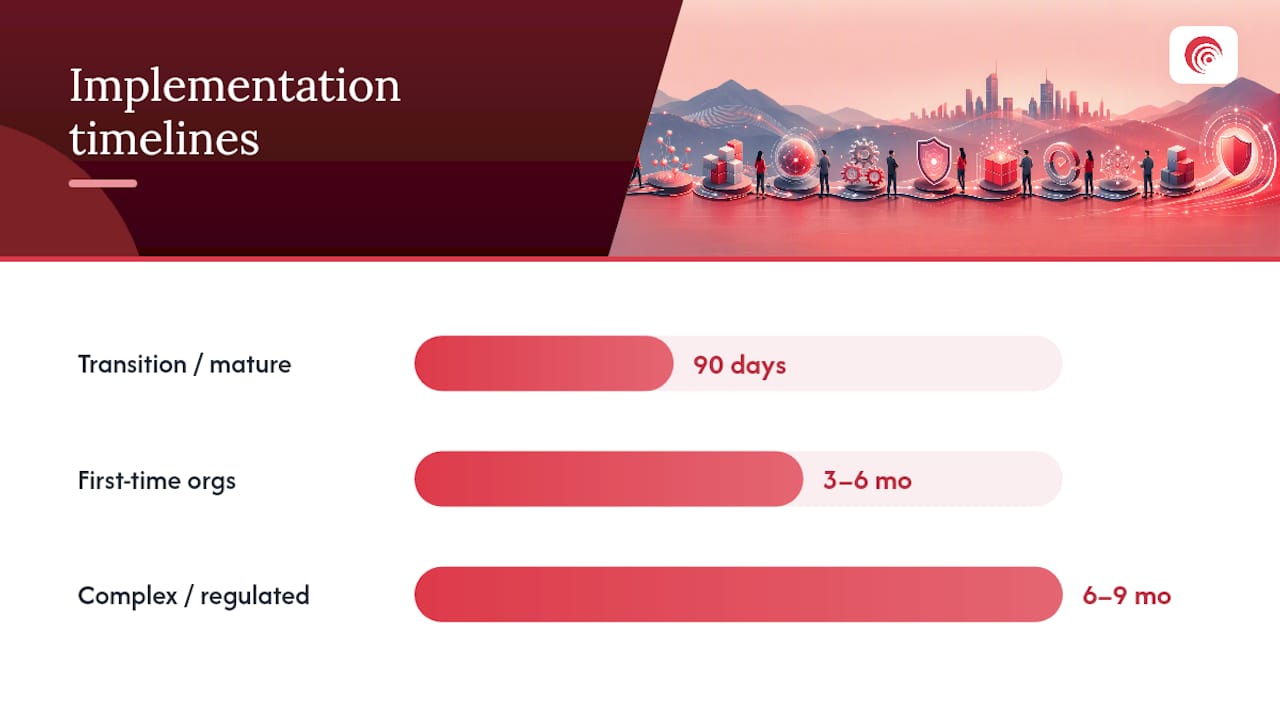
Timeline depends heavily on where you're starting from. A 90-day plan works for organizations transitioning an existing ISMS to the 2022 revision or those with mature security practices already in place, an approach ISACA's transition guidance frames as achievable but tight. Most first-time implementations run 3 to 6 months. Complex, multi-site, or highly regulated organizations should plan for 6 to 9 months.
Pro Tip: Book the certification audit dates before you finish implementation. Certification bodies often have 6 to 10 week lead times, and locking a date creates the internal deadline pressure that keeps a project from sliding indefinitely.
How Do You Define Scope Without Overextending the Project?
Scope decisions determine audit cost more than almost any other variable, because certification bodies price their days against the number of people, sites, and systems inside the boundary. A narrow, well-justified scope, one product line, one data center, one business unit, can be certified faster and cheaper than a company-wide scope, and it still satisfies most customer and procurement requirements if the sales contract language matches.
Document three things clearly under Clause 4:
- Boundaries — which systems, locations, teams, and third parties fall inside the ISMS, stated in a single scope statement your auditor can quote back to you.
- Interested parties — customers, regulators, employees, and vendors, along with what each one expects from your security program.
- Internal and external issues — competitive pressures, legal obligations, and technology dependencies that shape your risk landscape.
Multi-site organizations have an underused lever here: IAF MD1 sampling rules let auditors sample a subset of locations instead of visiting every site, provided the ISMS is centrally managed with consistent controls. That single design choice, centralizing your security program rather than letting each office run its own version, can cut audit days significantly across a distributed footprint.
How Do You Run the Risk Assessment and Build the SoA?
The risk assessment is where most first-time implementers either build something genuinely useful or produce a spreadsheet nobody ever opens again. Start by defining risk criteria: what counts as low, medium, and high likelihood, and what counts as low, medium, and high impact, stated in terms your leadership team actually understands (dollars, downtime hours, regulatory exposure).
Build an asset register next, covering data, systems, and processes, not just servers. A simple scoring template works: list the asset, the threat, the existing control, a likelihood score of 1 to 5, an impact score of 1 to 5, and a resulting risk rating. Anything above your defined threshold moves into risk treatment.
The Statement of Applicability is the document auditors scrutinize hardest, because it's the bridge between your risk assessment and your actual controls. Every one of the 93 Annex A controls needs a line in the SoA stating whether it's applicable, and why, or why not.
- Controls marked "applicable" need a one to two sentence justification tied to a specific risk, not a copy-pasted description of the control itself.
- Controls marked "not applicable" need an equally specific reason (no cloud infrastructure means certain cloud security controls genuinely don't apply).
- Every applicable control needs an owner and a link to the evidence that proves it's operating, not just documented.
- Sign-off belongs to top management, not just the ISMS lead, since the SoA is a formal commitment the certification body will hold you to.
First-year budgets for ISO 27001 commonly land between $10,000 and $50,000, with ongoing maintenance running $5,000 to $25,000 annually. Risk assessment and SoA work typically consumes the largest chunk of internal labor hours in that first-year total, more than the certification audit itself.
How Do You Select and Map Annex A Controls?
The 2022 revision consolidated Annex A from 114 controls down to 93, reorganized into four groups instead of the old fourteen domains. That change, documented in ISACA's transition analysis, simplified navigation but didn't reduce the actual work of implementation. Organizations still certified under the 2013 version need a gap assessment against the new structure before their next audit cycle.
The four control groups, and what each typically covers in practice:
- Organizational controls (37 controls) — policies, roles, supplier relationships, and incident management procedures; mostly documentation and governance work.
- People controls (8 controls) — screening, terms of employment, security awareness training, and disciplinary processes.
- Physical controls (14 controls) — facility access, equipment security, and clear desk/clear screen practices.
- Technological controls (34 controls) — access control, cryptography, logging, network security, and secure development practices.
Document each selected control in the SoA with a pointer to where the evidence lives, a policy document, a screenshot of a configuration, a log export, rather than a paragraph restating the control's definition. The most common mistake at this stage is control overreach: implementing every possible technical control regardless of whether the risk assessment justifies it, which burns budget and creates maintenance debt nobody asked for.
What Documentation Do Auditors Actually Expect to See?
Certification bodies aren't grading you on the length of your policy binder. They're checking whether documented information matches what actually happens day to day, and mismatches between the two are the single fastest way to generate a nonconformity.
The minimum documented set includes:
- Information security policy, signed by top management and reviewed at least annually.
- Scope statement and Statement of Applicability, kept current as systems change.
- Risk assessment methodology and risk treatment records.
- Operating procedures for the controls the SoA marks as applicable.
- Internal audit reports and management review minutes.
- Corrective action records showing how nonconformities got resolved.
Auditors spot boilerplate quickly, mismatched terminology between a downloaded template and the language your team actually uses, or a procedure describing a tool you don't run. Templates are a legitimate starting point, especially for smaller organizations following the ISO handbook approach for SMEs, but every template needs editing to reflect your real environment before it becomes evidence.
Pro Tip: Link every policy statement to a log, ticket, or record that proves it happened. A change management policy is worth nothing to an auditor without a change log showing approvals, and that link is exactly what separates "documented" from "operating effectively."
Which Technical Controls Give You the Clearest Audit Evidence?
Some controls generate audit evidence almost automatically once they're configured correctly. Others require manual tracking that eats hours every month. Prioritizing the automatic-evidence controls first is one of the highest-leverage moves in the entire implementation.
Controls that consistently produce clean, exportable evidence:
- Centralized logging and SIEM tooling, which timestamps every access event without manual intervention.
- Identity and access management (IAM) with role-based permissions and automated deprovisioning.
- Mobile device management (MDM) for endpoint compliance and encryption status.
- Automated backup systems with success/failure logs.
- Vulnerability scanning and patch management dashboards showing remediation timelines.
- Endpoint detection and response (EDR) tools generating incident and alert histories.
GRC and compliance automation platforms pull evidence directly from cloud stacks (AWS, Microsoft 365, Google Workspace) and continuously map it to Annex A controls, which is where a meaningful chunk of manual audit prep time disappears. Combining an automation platform with a fractional consultant tends to beat both a pure do-it-yourself approach and a fully consultant-led engagement on time-to-certification and total cost, according to AXIPRO's cost analysis.
Budget-constrained organizations should prioritize logging and IAM first, since those two controls touch the largest number of Annex A requirements and produce evidence auditors ask for repeatedly across different control families.
What Should You Check Before Inviting a Certification Body?
Internal audit and management review aren't bureaucratic formalities. They're the dress rehearsal that determines whether your Stage 2 audit goes smoothly or turns into a list of nonconformities.
- Confirm auditor independence. The person conducting the internal audit cannot review their own work; small organizations often contract an outside internal auditor for this reason.
- Sample intelligently. Distributed organizations don't need to audit every location every cycle. Rotate site coverage year to year while sampling every control family annually.
- Compile management review inputs. Bring internal audit results, security incidents, performance metrics, and status on prior corrective actions to the review meeting.
- Produce management review outputs. Leadership should leave the meeting having approved specific actions and resource requests, documented in minutes.
- Run a pre-audit readiness check. Walk through the SoA line by line and confirm evidence exists for every "applicable" control before the certification body shows up.
- Prioritize fixes by audit risk. Fix anything touching access control, incident response, or backup evidence first. These are the areas certification bodies sample most heavily.
Organizations that treat the internal audit as a genuine stress test, rather than a checkbox before the real audit, walk into Stage 2 with far fewer surprises.
How Much Does Certification Cost, and What Do Stage 1 and Stage 2 Actually Involve?
Stage 1 is a documentation review: the auditor checks whether your policies, scope, and SoA are complete and internally consistent, and whether you're ready for Stage 2. Common outcomes include minor observations you can fix in a week or two. Stage 2 tests whether controls actually operate as documented, through interviews, evidence sampling, and walkthroughs of real processes. Most certification processes run these as two distinct visits, often several weeks apart, followed by annual surveillance audits and full recertification every three years.
Auditors calculate the number of audit days using your effective headcount (people who touch the ISMS scope, not total company size) and site count. Multi-site organizations with centralized, consistent controls can qualify for reduced sampling under IAF MD1 rules, which directly lowers audit fees.
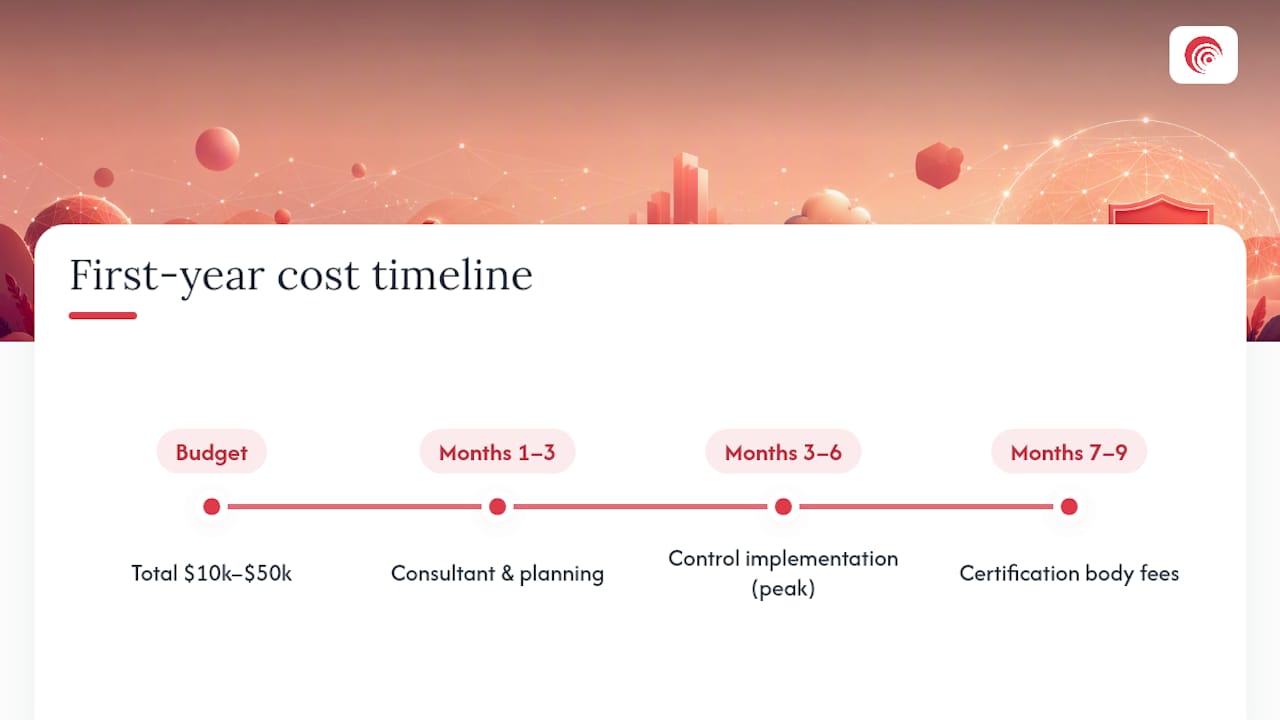
First-year ISO 27001 costs commonly fall between $10,000 and $50,000 for small to mid-size organizations, with the bulk of spend concentrated in months 3 through 7, the implementation and internal audit phases, rather than the certification audit itself. Budget for consultant or automation platform costs early (months 1 to 3), control implementation spend in the middle (months 3 to 6), and certification body fees toward the end (months 7 to 9). Organizations that front-load documentation work without budgeting for the technical control rollout often hit a cash crunch right before Stage 1.
How Do You Keep the ISMS Running After Certification?
Certification isn't the finish line. Surveillance audits happen annually, and they check whether the ISMS is still operating, not just whether it once did. Skipping internal audits or letting the risk register go stale between certification cycles is the fastest way to fail a surveillance visit.
Build a light annual cadence: one or two internal audits, a mid-year and year-end management review, and continuous metric collection rather than a scramble the month before the surveillance date. Useful KPIs to track on an ongoing basis:
- Security incidents identified and time-to-resolution.
- Patch management cadence (percentage of critical patches applied within your defined SLA).
- Internal audit findings closed within their target timeframe.
- Percentage of Annex A controls with evidence updated in the last 90 days.
Organizations pursuing SOC 2 or aligning with the NIST Cybersecurity Framework alongside ISO 27001 can map shared controls once and reuse evidence across programs, since access control, logging, and incident response requirements overlap heavily between ISO 27001, SOC 2, and NIST CSF. Building one evidence repository instead of three separate ones is the difference between compliance feeling manageable and feeling like a second job.
A Managed Approach to ISO 27001 Implementation
Organizations that run ISO 27001 implementation as a side project alongside existing IT and security work often lose months to competing priorities. A team dedicated to the certification, whether internal or managed, tends to move through the risk assessment and control implementation phases faster simply because nothing else competes for their attention.
MARFI's managed compliance model runs continuous GRC operations rather than treating ISO 27001 as a one-time project, pairing that with 24/7 SOC monitoring and SOC 2 Type II evidence generation that overlaps directly with Annex A technical controls. That overlap matters: work done for one framework often counts as evidence for another, which is where a lot of implementation time gets saved.
A managed approach tends to fit best when:
- Internal IT or security staff are already stretched across daily operations and can't dedicate sustained hours to documentation and evidence work.
- The organization needs SOC 2 and ISO 27001 simultaneously and wants shared evidence rather than two parallel projects.
- Leadership wants continuous monitoring and audit readiness year-round, not just a sprint before the certification date.
Typical engagements start with a scoping conversation, move into a gap assessment against current controls, and produce a proposal with a defined timeline before any implementation work begins.
Do Employees Really Need Security Training for ISO 27001?
Yes, and Annex A makes it a named control, not an afterthought. Clause 7.3 requires employees to understand the information security policy and their role in it, while the people control group under Annex A specifically calls for security awareness education as part of the control set.
Training needs to happen at three points: during onboarding, annually for the whole organization, and immediately after any significant policy change. Content should cover phishing recognition, password and access hygiene, data handling rules specific to the organization's scope, and incident reporting procedures, who to contact and how fast.
Auditors test this control by interviewing staff, not by reviewing a training completion spreadsheet. A Stage 2 auditor asking a random employee "what would you do if you clicked a suspicious link" and getting a blank stare is a common way organizations pick up a minor nonconformity they didn't see coming. Documented training records matter, but so does the actual retention: quarterly phishing simulations tend to catch gaps that annual training alone misses.
Keep training records tied to specific policy versions, so when a policy updates, you can show exactly which employees were retrained and when. That link between policy change and retraining evidence is exactly what a surveillance auditor checks in year two.
The Real Bottleneck Isn't the Standard, It's Sequencing
Most ISO 27001 projects don't fail because a control was missing. They fail because teams implemented controls before finishing the risk assessment, or wrote policies before deciding what the SoA would actually claim. The standard rewards discipline in order, not effort in volume.
The conventional advice, "start with policies", gets this backward. Start with the risk assessment, because everything downstream, the SoA, the control selection, the documentation, depends on it being right first. Teams that skip ahead end up rewriting policies twice, which is where most timeline overruns actually come from.
If you take one thing from this checklist, prioritize evidence generation over documentation volume. A ten-page policy nobody follows is worth less to an auditor than a two-page policy with six months of matching logs behind it. Certification bodies test operation, not intention, and the gap between the two is where most first-time implementations lose weeks they didn't budget for.
— Danny
Get Managed Support for Your ISO 27001 Implementation
Marfi is the alternative to piecing together a consultant, a template library, and an internal project manager separately: one accountable team runs your compliance operations, technical controls, and audit evidence collection under a single engagement. That matters most in the control implementation and evidence phases, where most first-time projects lose the most time.
Marfi's managed compliance and continuous GRC services handle Statement of Applicability development, evidence mapping, and ongoing monitoring so your ISMS stays audit-ready year-round instead of scrambling before each surveillance visit. Pair that with 24/7 SOC and managed cybersecurity for the logging, IAM, and monitoring evidence Annex A's technological controls require, plus managed IT services for change control and incident response records auditors sample directly.
Engagements typically start with a scoping call and gap assessment against your current environment, followed by a proposal with a defined implementation timeline. If you're planning ISO 27001 implementation this year, start a compliance scoping conversation and get a realistic timeline back before you commit a budget.
Where to Learn More
Consult the official ISO/IEC 27001:2022 standard page for the authoritative requirements text, ISACA's transition guidance for 2022 revision planning, and AXIPRO's cost breakdown for detailed budget benchmarks.
Sources
- Navigating the ISO/IEC 27001:2022 transition — a 90-day challenge (ISACA Journal, 2024)
- ISO 27001 Certification Cost in 2026: Full Breakdown (AXIPRO)
- ISO 27001 Certification Process (Stage 1, Stage 2 and Ongoing Audits)