

MDR focuses on fast detection and hands-on containment; an MSSP focuses on managing your security infrastructure, tools, and compliance reporting. Pick MDR if you need 24/7 active threat containment without building an internal team. Pick an MSSP if your bigger gap is managing SIEM, firewalls, and audit-ready evidence across a sprawling environment. Many organizations require both capabilities, which is why some integrated providers combine these services under one accountable team.
TL;DR:
- MDR provides 24/7 active threat detection, investigation, and containment, focusing on quick response times and multi-source telemetry, including identity and cloud data.
- MSSP manages security tools, compliance reporting, and operational oversight, but typically escalates alerts to your internal team rather than owning containment actions.
- Combining both services under one accountable provider reduces handoff errors, speeds incident response, and simplifies compliance documentation for frameworks like SOC 2 and CMMC.
- Pricing differences reflect scope: MDR costs scale with endpoints and telemetry volume, while MSSP fees relate to managed devices and tools, with neither model inherently cheaper.
- For organizations with limited internal security resources or facing regulatory audits, layering MDR on top of MSSP services offers the most comprehensive and efficient coverage.
Table of Contents
- MSSP vs. MDR: What Actually Separates the Two Models
- The MSSP Model: What You're Actually Buying
- MDR vs. MSSP: The Decisions That Actually Matter
- Which Organizations Should Choose MDR, MSSP, or Both
- Where MSSP and MDR Overlap, and Why That's Not a Coincidence
- How to Choose a Provider: Checklist, Questions, and Red Flags
- Why a Single Accountable Provider Closes the Gap
- What I'd Actually Tell a Buyer Sitting on This Decision
- Get Both Operational Breadth and Active Response Under One Team
- Sources
MSSP vs. MDR: What Actually Separates the Two Models
The confusion around MSSP vs MDR comes from overlapping marketing language, not overlapping function. Rapid7 draws the line clearly: MDR is built around detection, investigation, and response, while an MSSP is built around monitoring and managing the security infrastructure itself, plus the reporting that comes out of it.
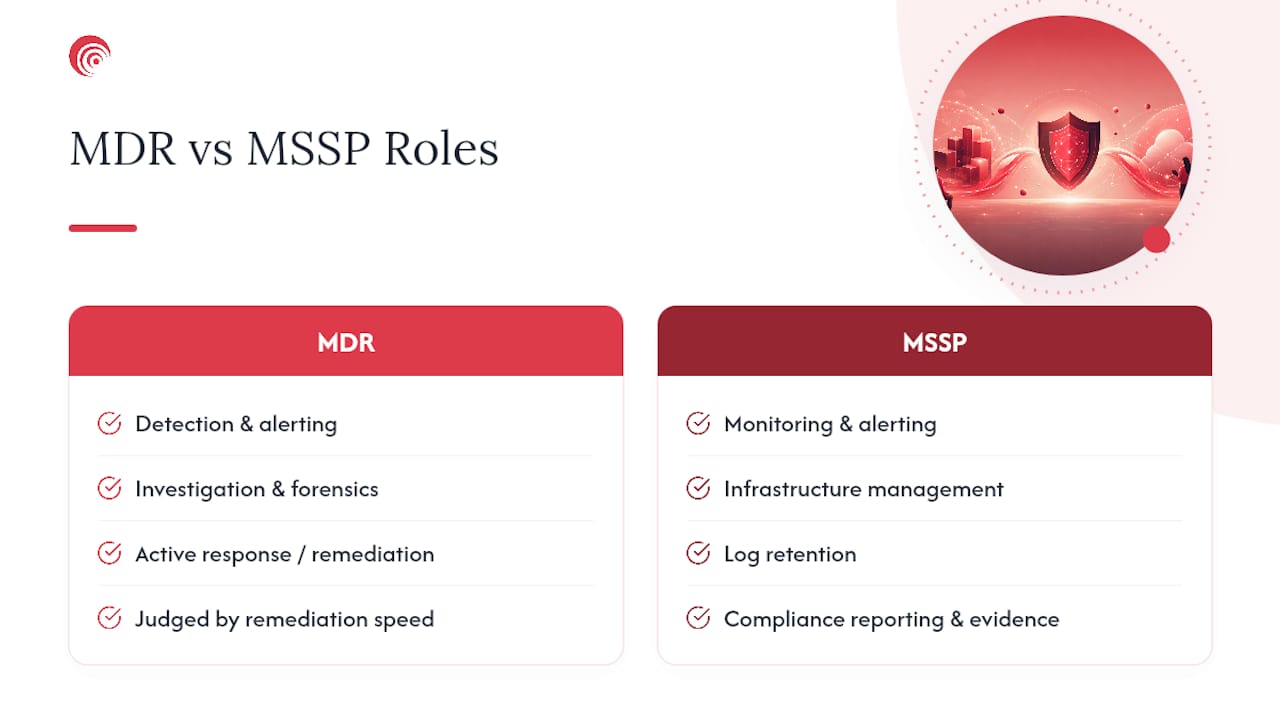
Think of it as a difference in job description. An MDR provider is judged on how fast it spots an attacker and shuts them down. An MSSP is judged on how well it keeps your tools running, your logs retained, and your compliance evidence organized. Neither role is lesser. They just solve different problems, and a lot of buyers assume one vendor covers both when it doesn't.
What MDR actually is
MDR (managed detection and response) is a service that pairs telemetry and automation with human analysts who actively hunt threats and take response actions on your behalf. Microsoft's own documentation for Defender Experts MDR describes exactly this combination: automated triage backed by analysts who investigate incidents and execute managed response, with the ability to pull in third-party telemetry through a SIEM layer like Microsoft Sentinel.
A functioning MDR service typically includes:
- 24/7 monitoring across the telemetry sources you've connected, not just business hours coverage
- Threat hunting that looks for attacker behavior patterns, not just signature matches
- Triage and investigation that separates real incidents from noise before they hit your team
- Containment or guided remediation, meaning the provider (not just you) can isolate a device, disable an account, or quarantine a file
Telemetry is the fuel here. Solid MDR pulls from endpoints (via EDR), identity systems, email, cloud workloads, and network traffic. The more sources feeding the detection engine, the fewer blind spots an attacker can hide in during a multi-stage intrusion. That's also why MDR has been evolving into MXDR, extending detection beyond the endpoint into identity and cloud telemetry that older EDR-only tools never touched.
Outcome-focused metrics matter more than feature lists here. Ask any MDR vendor about their time-to-detect and time-to-contain, not just their monitoring hours. Response speed is the entire value proposition of MDR security solutions. A provider that takes six hours to isolate a compromised laptop isn't meaningfully different from an MSSP that just emails you an alert.
The MSSP Model: What You're Actually Buying
An MSSP (managed security service provider) manages your security tools, operations, and reporting across your environment rather than owning the detection-to-response pipeline end to end. It's a provider model built around operational breadth, not a narrow capability focused on stopping active attackers.
A typical MSSP engagement covers:
- SIEM management, including rule tuning, log ingestion, and alert generation
- Firewall and network device administration, keeping rulesets current and devices patched
- Vulnerability scanning on a recurring schedule, with prioritized findings
- Log retention that satisfies audit and regulatory timelines
- Compliance reporting mapped to frameworks like SOC 2, HIPAA, or NIST
Here's the part buyers miss most often: a traditional MSSP usually escalates alerts to your internal team rather than owning containment itself. The MSSP tells you something looks wrong; your team decides what to do about it. That's a reasonable division of labor if you already have security staff who can act on escalations. It's a serious gap if you don't.
Where MSSPs earn their keep is operational consolidation. Managing five or six point tools (SIEM, firewall, vulnerability scanner, log archive, ticketing) is a full-time job on its own, and most mid-market IT teams don't have anyone dedicated to it. An MSSP absorbs that grind and hands you audit-ready evidence when a regulator or a customer's security questionnaire comes asking. If your last SOC 2 audit turned into a three-week scramble for screenshots and log exports, that's the exact pain an MSSP is designed to remove.
The tradeoff is speed of action during an actual incident. An MSSP watching your SIEM might flag anomalous login activity within minutes, but if the response plan requires your team to review and approve containment, the attacker has that entire window to move laterally.

MDR vs. MSSP: The Decisions That Actually Matter
Once you get past definitions, the real evaluation happens across a handful of dimensions that determine what you're actually paying for and what you're on the hook to do yourself.
| Dimension | MDR | MSSP |
|---|---|---|
| Primary goal | Detection and active response | Monitoring and managing security infrastructure |
| Response ownership | Provider typically executes containment | Provider usually escalates; client's team acts |
| Telemetry coverage | Endpoint (EDR), identity, email, cloud, network via MXDR/XDR | SIEM logs, firewall data, scan results |
| Pricing shape | Per-endpoint or per-user, scales with telemetry volume | Per-device, per-tool, or tiered service bundles |
| Best for | Orgs needing active containment without internal staff | Orgs needing tool management and compliance reporting |
| Compliance reporting | Incident-focused evidence, less operational reporting | Strong audit trails, log retention, framework mapping |
Who owns the moment an alert becomes an incident
This is the single most consequential difference. With MDR, the provider is contractually expected to take action, isolating a host, killing a malicious process, disabling a compromised account, and to do it without waiting on your sign-off during active exploitation. With an MSSP, that decision usually sits with you. Kaseya frames this well: MDR is a capability built around response, while MSSP is a provider model built around management, and the two aren't interchangeable just because both watch your environment.
Telemetry breadth changes what you can actually see
A service watching only endpoint data misses an attacker who pivots through a compromised cloud identity or a phishing email that never touches a managed device. MXDR closes that gap by operationalizing telemetry from identity, email, cloud, and network sources alongside endpoint data, which matters enormously for multi-stage attacks that never trip a single sensor. Ask any MDR vendor what telemetry sources are actually included versus available as an add-on. That distinction shows up in the invoice fast.
Pricing shape and what drives the cost up
MDR pricing usually scales with the number of protected endpoints or users and the volume of telemetry ingested. Add identity and cloud coverage, and the price climbs, because more data sources mean more analyst hours spent on triage. MSSP pricing tends to bundle around the number of managed devices or tools, with tiered service levels (basic monitoring vs. full management) driving the range. Neither model is inherently cheaper. The real cost driver is scope: how many systems, how much data, and how fast you need a human to act on what's found.
Statistic Callout: Vendor MDR pages, including CrowdStrike's Falcon Complete overview, increasingly market median time-to-contain as the headline performance metric rather than uptime or alert volume. That shift reflects a broader industry move toward outcome-based SLAs: containment speed, not dashboard coverage, is becoming the number vendors are judged on.
Compliance implications you can't ignore
If your organization needs to prove continuous monitoring and log retention for a SOC 2 audit or CMMC assessment, an MSSP's operational reporting often maps more directly to what auditors want to see. MDR reporting tends to be incident-centric: what happened, when, and how it was contained, which is valuable but doesn't replace the ongoing evidence trail auditors expect. Organizations in regulated industries frequently need both streams of documentation, not one or the other.
Pro Tip: Before signing with any MDR vendor, ask them to walk through a redacted real incident, from first detection to final containment, and show you exactly who performed each action and how the evidence was packaged for you afterward. If they can only describe response in the abstract, you're likely buying alerting with a response label attached, not actual managed response.
Which Organizations Should Choose MDR, MSSP, or Both
The right model depends less on company size and more on what gap you're actually trying to close. A handful of common profiles cover most buyers:
-
SMB with no internal SOC. You have IT generalists, not security specialists, and no one available at 2 a.m. when ransomware starts encrypting file shares. MDR is usually the better first purchase because it puts trained analysts and containment authority between your data and an attacker, without requiring you to hire anyone.
-
Regulated enterprise facing audit pressure. If SOC 2, HIPAA, or CMMC compliance is driving the purchase, an MSSP's strength in log retention, tool management, and reporting often matters more than raw response speed, at least initially. That said, regulators increasingly expect demonstrated incident response capability too, which pulls many of these organizations toward a combined model over time.
-
Enterprise with a partial internal SOC. You have a security team, but they're stretched thin and can't staff overnight coverage. MDR complements what you already have by extending detection and response into the hours your team can't cover, rather than replacing anyone.
-
Multi-tool environment drowning in operational overhead. If your team spends more time patching firewalls and tuning SIEM rules than actually hunting threats, an MSSP's operational consolidation frees up hours that are currently going to tool maintenance instead of security outcomes.
-
Fast-growing company scaling past its security headcount. Growth often outpaces hiring, and the ISC2 Cybersecurity Workforce Study documents a persistent talent gap that makes qualified security hires hard to find and expensive to retain. Outsourcing detection and response to a managed provider is often faster than filling three open analyst roles.
-
Regulated organization that needs both breadth and depth. Defense contractors, healthcare providers, and financial services firms frequently need MSSP-style tool management and compliance evidence and MDR-style active containment. Trying to stitch these together across two separate vendors creates handoff gaps exactly when speed matters most.
Compliance requirements often tip the decision. A company chasing CMMC certification for a defense contract needs documented, continuous monitoring evidence that an MSSP is built to produce. But if that same company suffers an actual intrusion attempt, documentation alone doesn't stop lateral movement. That's the scenario where layering MDR on top of MSSP services, or choosing a provider that does both under one roof, stops being a nice-to-have and starts being the only model that actually closes the loop.
Where MSSP and MDR Overlap, and Why That's Not a Coincidence
The lines between MSSP and MDR have blurred on purpose. Many MSSPs now offer MDR as an add-on tier because their clients kept asking for active response, not just alerts. Conversely, some MDR providers now manage a portion of the underlying tooling (SIEM configuration, EDR agent deployment) because clients didn't want to coordinate two separate vendors for what feels like one connected problem. Kaseya's analysis of the overlap notes that combining both is common precisely because breadth and depth solve different failure modes.
MXDR is the technical driver behind a lot of this convergence. Instead of stopping at endpoint telemetry, MXDR pulls in identity, email, and cloud signals, which means a single service can now do what used to require separate MSSP monitoring of email gateways and separate MDR monitoring of endpoints. That consolidation reduces the blind spots that show up specifically in multi-stage attacks, where an intruder starts with a phished credential, pivots through cloud storage, and only touches an endpoint in the final stage.
Integration between MSSP, MDR, SIEM, and any internal SOC you already run typically works like this:
- The SIEM ingests logs from across the environment, whether managed by an MSSP or fed into an MDR platform
- MDR analysts triage and investigate flagged activity, often within the same console the SIEM populates
- Confirmed incidents trigger containment actions, which then get logged back into the SIEM or ticketing system for the record
- Internal SOC staff, where they exist, receive escalations for anything requiring business context the provider doesn't have
The handoff points are where most failures happen in practice, not the individual tools themselves. A well-run combined engagement defines those handoffs in writing: who gets notified, how fast, and who has authority to act, before an incident forces the question.
How to Choose a Provider: Checklist, Questions, and Red Flags
Picking between MDR security solutions and MSSP offerings, or deciding to combine them, comes down to asking the right questions before you sign anything. Work through this in order during vendor evaluation:
-
What telemetry sources are actually included? Get a specific list: endpoint, identity, email, cloud, network. Anything listed as an "available integration" rather than "included" is a future cost.
-
Do we get access to raw telemetry and logs, or only the provider's summarized alerts? You need the ability to audit what's actually happening in your environment independent of the vendor's dashboard.
-
Who performs the actual containment action, and under what authority? Get this in writing. "We recommend containment" and "we execute containment" are two very different services with two very different price tags.
-
What are the specific SLA commitments for time-to-detect and time-to-contain? Vague language like "rapid response" means nothing in a contract dispute. Insist on numbers.
-
What does the compliance evidence and reporting format actually look like? Request a sample report before signing, not after your first audit deadline.
-
What's the escalation path when something falls outside the standard playbook? Every environment eventually produces an edge case. Know who you're calling at 3 a.m.
On the contract side, pay close attention to termination clauses (can you exit within 30 to 90 days if service quality slips?), liability language around incident response failures, and whether the contract requires the provider to preserve forensic evidence for a defined period after containment.
Watch for these red flags during evaluation:
- Black-box alerting where you can't see the underlying logic or telemetry behind an alert
- No named human analyst oversight, meaning everything is automated with no one reviewing edge cases
- Vague escalation paths that don't specify response times or named contacts
- Missing compliance evidence samples, meaning the provider can't show you what an audit-ready report actually looks like before you sign
Pro Tip: Ask every finalist vendor for a live runbook demo, walking through detection to containment step by step, and request documented proof of their historical mean time to contain. A provider confident in their process will show you the mechanics without hesitation. One that stalls on this request is telling you something about how their response actually works.
Why a Single Accountable Provider Closes the Gap
Buyers who split MSSP and MDR across two vendors often discover the split creates its own risk: finger-pointing during an actual incident, unclear containment authority, and compliance evidence that lives in two disconnected systems. A single accountable team removes that friction by design.
When evaluating any provider claiming to offer both, verify a few concrete things rather than taking the pitch at face value:
- 24/7 SOC coverage, confirmed with actual staffing details, not just marketing language about "round the clock" monitoring
- SOC 2 Type II certification, which demonstrates audited controls over time rather than a point-in-time assessment
- Compliance readiness for frameworks relevant to your industry, whether that's CMMC, NIST SP 800-171, HIPAA, or FedRAMP
- Documented containment authority, spelled out in the contract, not implied in a sales call
Marfi is built around exactly this combination: a 24/7 security operations center, SOC 2 Type II certification, and compliance readiness across frameworks like CMMC and NIST, delivered by one accountable team rather than stitched together from separate vendors. That structure matters most in the moment an incident actually happens, when a client needs one team that already knows their environment, not a phone tree between a monitoring vendor and a response vendor arguing about who owns the next step.
What I'd Actually Tell a Buyer Sitting on This Decision
If you're a smaller or mid-market company without dedicated security staff, starting with MDR can be beneficial. The exposure of going without active containment outweighs the operational tidiness an MSSP offers, especially given how thin the talent pool remains for hiring your way out of the gap. If you're a regulated enterprise drowning in tool sprawl and audit prep, an MSSP-first approach probably solves the more urgent pain, but don't stop there. Layer in response capability before your next incident forces the issue.
For most organizations reading this, the honest answer is combined coverage, not a binary choice. The two models fail differently: MSSP without response ownership leaves you exposed during active exploitation, and MDR without operational breadth leaves your compliance evidence scattered.
Whichever direction you lean, don't sign anything before running a short pilot, demanding a live runbook demonstration, and requesting actual compliance evidence samples. Confirm response authority in writing before an incident forces that conversation under pressure. The contract language you skim past during procurement is exactly what gets litigated when something goes wrong at 2 a.m.
— Danny
Get Both Operational Breadth and Active Response Under One Team
Splitting MSSP and MDR across separate vendors means splitting accountability too, and that split shows up exactly when you can least afford it: during an active incident, with two providers pointing at each other's contract language. Marfi closes that gap by running managed IT, 24/7 security operations, and compliance readiness under a single accountable team instead of a patchwork of specialists who each own one slice of the problem.

That means one team monitoring your environment, one team with containment authority when something goes wrong, and one set of audit-ready evidence covering frameworks like SOC 2, HIPAA, CMMC, and NIST SP 800-171. If your organization is weighing whether to bolt MDR onto an existing MSSP relationship or start fresh with a combined provider, a discovery call is the fastest way to get clarity. Come prepared with your current telemetry sources, your compliance deadlines, and a list of the escalation gaps that worry you most. From there, Marfi's managed cybersecurity and 24/7 SOC services can show you exactly where a single accountable team would change your incident response timeline.
Sources
- MDR vs MSSP | Rapid7 fundamentals
- MDR vs. MSSP: Key Differences and How They Overlap | Kaseya
- 2025 ISC2 Cybersecurity Workforce Study