

The NIST AI RMF is voluntary U.S. guidance, first published January 26, 2023, that helps organizations manage risk across the AI lifecycle through four functions: Govern, Map, Measure, and Manage. Nothing in it is legally mandatory, but procurement teams, auditors, and regulators increasingly treat it as the baseline. If you haven't started, the move now is simple: build a system inventory and assign named risk owners before your next AI deployment goes live.
TL;DR:
- Building a system inventory and assigning risk owners are critical first steps before deploying AI models, especially for organizations with shadow AI projects.
- The AI RMF cycle should be revisited regularly, with iteration at Map and Measure phases whenever models are retrained or use cases expand.
- Producing documented artifacts such as model cards, evaluation reports, and go/no-go approval records is essential for audit readiness and vendor evaluations.
- Implementing the framework in phases—starting with governance, then mapping and measuring, followed by management—accelerates compliance and reduces overwhelm.
- Using the AI RMF artifacts to align with standards like ISO/IEC 42001 and updating them as regulations evolve minimizes redundant efforts.
Table of Contents
- What Does the NIST AI RMF Actually Cover?
- How Do the Four Core Functions Work Together?
- When Should You Use the AI RMF Playbook and Generative AI Profile?
- How Do You Roll Out the AI RMF in Phases?
- What Evidence Should You Be Producing Right Now?
- How Does AI RMF Evidence Map to ISO/IEC 42001 and Other Standards?
- Why Most Organizations Get AI RMF Adoption Wrong
- Let Marfi Turn the AI RMF Into an Audit-Ready Program
- Where to Find the Official NIST AI RMF Documents
- Sources
What Does the NIST AI RMF Actually Cover?
The framework applies to any organization designing, developing, deploying, or using AI systems, regardless of sector. NIST calls this population "AI actors," a deliberately broad term covering data scientists, procurement officers, executives who approve budgets, and third-party vendors supplying models. That breadth is why the framework shows up in vendor questionnaires far more than most people expect.
The AI RMF is voluntary by design. NIST built it to be adaptable across industries rather than prescriptive like a regulation, which means adoption depends on organizational judgment about risk tolerance. But voluntary doesn't mean optional in practice. Federal procurement guidance and agency memos increasingly expect alignment with AI RMF principles, so vendors selling into government or regulated markets face de facto pressure to comply.
NIST treats the document as living, not static:
- The AI RMF 1.0 publication carries a DOI and formal versioning, signaling NIST's intent to revise it as AI risk understanding matures.
- A companion Generative AI Profile already extended the Core to GenAI-specific hazards in 2024.
- Expect continued refinement through 2028 as agency feedback and real-world incidents shape future revisions.
How Do the Four Core Functions Work Together?
GOVERN sits apart from the other three. NIST built it as cross-cutting infrastructure that has to exist before Map, Measure, and Manage produce anything trustworthy. Skip Govern and you get scattered risk assessments with no one accountable for the decisions they surface.
Here's what each function looks like in practice:
- Govern builds the foundation: a program charter, a documented risk tolerance statement, an AI risk committee with real authority, and contract language covering third-party model providers.
- Map produces the system inventory. Every model gets a use case description, an impact assessment, and a risk tier (low, medium, high). This function ends in a go/no-go decision gate before deployment.
- Measure attaches numbers to risk: accuracy benchmarks, fairness metrics across demographic groups, robustness tests against adversarial inputs, and a defined cadence for retesting.
- Manage turns findings into action: treatment plans for identified risks, incident response runbooks, and continuous monitoring once the system is live.
NIST is explicit that these functions aren't a linear checklist. You cycle back through Map and Measure every time a model gets retrained or a use case expands.
Pro Tip: Assign the go/no-go authority in Map to a named individual, not a committee. Diffuse authority is how "shadow AI" projects slip past review entirely.
A mid-size insurer using an AI underwriting model, for example, would produce a model card under Map, run quarterly fairness metrics under Measure, and maintain an incident runbook under Manage for when the model flags an unusual denial pattern.
When Should You Use the AI RMF Playbook and Generative AI Profile?
The AI RMF Playbook exists because the Core tells you what to do, not how. It maps specific suggested actions to each subcategory of Govern, Map, Measure, and Manage, so a compliance lead can turn "establish risk tolerance" into an actual checklist item with owners and deadlines.
If your organization builds on or deploys large language models, pair the Core with the Generative AI Profile, released in July 2024 to address risks the original Core didn't anticipate: hallucination, training data poisoning, and other GenAI-specific hazards across twelve risk categories.
Practical use looks like this:
- Start with the Core to set governance structure and risk tiers.
- Layer the Playbook's suggested actions onto each subcategory your team owns.
- Add the Generative AI Profile only for systems that involve generative or foundation models.
- Download official versions directly from NIST rather than third-party summaries, since the DOI-linked PDF is the authoritative version of record.
How Do You Roll Out the AI RMF in Phases?
Most compliance teams fail at AI RMF adoption not because the framework is complex, but because they try to implement all four functions simultaneously with no sequencing. A phased rollout fixes that.
Phase 1: Governance foundation (weeks 1 to 4). Draft the program charter, set risk tolerance thresholds, and stand up an AI risk committee with actual veto power over deployments. Build a RACI matrix naming who owns each Core function. This phase produces no AI-specific artifacts yet; it produces the structure that makes every later artifact credible.
Phase 2: Map and Measure cycles (weeks 5 to 16). Inventory every AI system in production or development, including shadow deployments business units built without IT's knowledge. Run impact assessments, assign risk tiers, and start collecting model cards. Establish your measurement cadence: what gets tested, how often, and against what thresholds.
Phase 3: Manage and deployment (weeks 17 to 24). Write treatment plans for every risk Measure surfaced above your tolerance threshold. Build incident response runbooks specific to AI failure modes (model drift, data poisoning, output manipulation). Stand up continuous monitoring so Measure doesn't stop once a system goes live.
That timeline fits a small program with a handful of models. Enterprise-scale organizations running dozens of AI systems across business units typically need 12 to 24 months to reach the same maturity, mostly because Phase 2's inventory work multiplies with every business unit that has its own shadow AI projects.
By the numbers: organizations following this phased approach report reaching audit-ready artifact status (inventory, risk owners, model cards, evaluation harness) in roughly 3 to 6 months for small-scale programs, versus 12 to 24 months at enterprise scale.
Whoever holds go/no-go authority in Phase 2 needs documented approval gates, not verbal sign-off. Auditors will ask for the paper trail, and procurement teams evaluating you as a vendor will ask the same question.
What Evidence Should You Be Producing Right Now?
Auditors and enterprise buyers don't want to hear that you follow the NIST AI RMF. They want the paper trail. Build these artifacts as you go rather than reconstructing them before an audit deadline:
- System inventory listing every AI model in production, development, or pilot, with owner and risk tier attached.
- Model cards documenting training data sources, intended use, known limitations, and performance benchmarks.
- Evaluation reports from each Measure cycle, timestamped and version controlled.
- Go/no-go approval records showing who authorized each deployment and what conditions applied.
- Risk treatment plans tied to specific findings, not generic boilerplate.
- Runtime evidence: monitoring logs, SIEM-forwarded alerts, and immutable session records for high-risk systems.
Pro Tip: Set a retention policy before your first audit request arrives. Version every model card and evaluation report so you can reconstruct exactly what the system looked like on any given date, not just its current state.
A basic evidence checklist for procurement reviews should map each artifact to the Core function it satisfies, which also happens to be the fastest way to answer an ISO/IEC 42001 auditor's first question.
How Does AI RMF Evidence Map to ISO/IEC 42001 and Other Standards?
Evidence produced once for AI RMF doesn't have to be produced again for every other framework you're chasing. NIST publishes crosswalks between AI RMF and standards like ISO/IEC 42001 and EU AI Act technical documentation requirements, which means your Govern charter and Map inventory can serve double duty.
The practical sequence:
- Map your existing GRC controls (ISO 27001, NIST CSF, SOC 2) onto Govern and Manage first, since most regulated organizations already have overlapping policy language there.
- Add AI-specific evidence only where gaps exist, typically in Map and Measure, since general IT controls rarely cover model-specific risk tiering or fairness testing.
- Layer ISO/IEC 42001 on top once you need a certifiable AI management system, using your AI RMF artifacts as the evidentiary backbone rather than starting a parallel documentation effort.
This overlay approach, treating AI RMF as the connective layer across existing GRC programs, is what keeps compliance teams from drowning in duplicate paperwork every time a new standard lands on their desk.
Why Most Organizations Get AI RMF Adoption Wrong
The mistake I see most often isn't skipping the framework. It's treating Govern as paperwork you file once and forget. NIST built Govern to be cross-cutting for a reason: every Map decision, every Measure threshold, every Manage escalation traces back to the risk tolerance and authority structure Govern establishes. Organizations that treat it as a one-time charter exercise end up with Measure metrics nobody reviews and Manage runbooks nobody follows, because there's no governing body actually accountable for acting on what those functions surface.
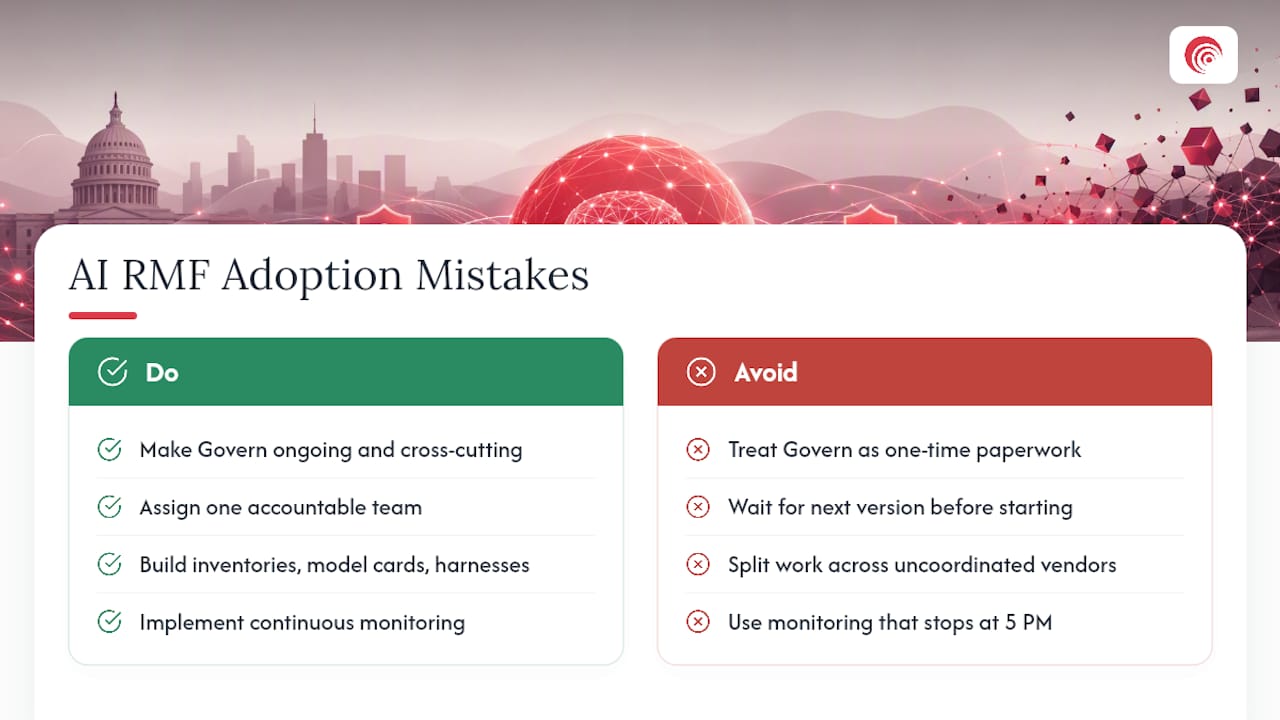
The other underestimated risk is complacency about revisions. Some teams wait for the "next version" before building anything, assuming their current work will become obsolete. It won't. Inventories, model cards, and evaluation harnesses built against AI RMF 1.0 stay relevant across future revisions because the underlying discipline, knowing what you've deployed and how it performs, doesn't change even when the guidance around it does.
Operationalizing this well takes an accountable team, not a binder. Marfi's secure AI governance work with regulated clients consistently shows that organizations who assign a single accountable team to Govern, Map, Measure, and Manage close their audit gaps faster than those splitting the work across five vendors who never talk to each other. Marfi runs a 24/7 security operations center and holds SOC 2 Type II certification, which matters here specifically because continuous monitoring, the backbone of Manage, requires infrastructure that doesn't clock out at 5 PM.
— Danny
Let Marfi Turn the AI RMF Into an Audit-Ready Program
Reading the framework is one thing. Producing a system inventory, model cards, and evaluation logs an auditor actually accepts is another. Marfi maps its services directly to the four Core functions: secure AI automation and governance for Measure and Manage, continuous compliance operations for Govern, and a 24/7 SOC that generates the runtime monitoring evidence Manage requires.
Instead of stitching together five vendors, one for governance policy, another for monitoring, a third for compliance paperwork, Marfi gives regulated organizations a single accountable team that owns the whole lifecycle. That matters most when an auditor asks for a document trail spanning Govern through Manage and you need one team who can produce it, not five who each hold a piece. Organizations preparing for CMMC or NIST SP 800-171 alongside AI RMF can also lean on Marfi's CMMC and DFARS readiness work to avoid building overlapping evidence programs twice.
Start with a readiness assessment. Marfi will review what's already deployed, flag the gaps against Govern, Map, Measure, and Manage, and hand you a phased plan scoped to your actual system count, not a generic template.
Where to Find the Official NIST AI RMF Documents
Go straight to primary sources rather than third-party summaries. The AI RMF landing page hosts the current framework and Generative AI Profile. The AI RMF 1.0 PDF carries the formal DOI. The Playbook supplies tactical actions, and Omnivance Media's implementation checklist offers a practical companion for teams building their first rollout plan.
Sources
- AI Risk Management Framework
- Artificial Intelligence Risk Management Framework (AI RMF 1.0)
- AI RMF Core - AIRC