

If you're a startup founder chasing an enterprise deal, aim for a Security-only Type I report as your fast unblocking credential, then convert to a Type II within several months for the report that actually holds up in procurement review. Budget $25,000 to $100,000 for your first year, with engineering time as the largest hidden line item, and expect a 4 to 8 month runway from kickoff to your first report. Startups without spare engineering bandwidth often shortcut this by pairing with a managed provider like Marfi, which already carries an SOC 2 attestation and can absorb the control work internally.
TL;DR:
- Startups should prioritize a Security-only Type I report initially, aiming to convert to Type II within several months to meet enterprise procurement standards.
- A typical SOC 2 audit costs between $25,000 and $100,000 in the first year, with engineering remediation as the largest hidden expense, and takes 4 to 8 months from start to report.
- Technical controls such as MFA, SSO, centralized logging, device encryption, and endpoint security are critical for reducing audit exceptions and ensuring control effectiveness over the observation window.
- Scope should be fixed early and documented in writing before conducting a gap analysis to avoid costly rescoping and evidence collection delays.
- For startups without spare engineering resources, managed services like Marfi can absorb remediation, ongoing evidence collection, and compliance operations to accelerate SOC 2 readiness.
Table of Contents
- What Is SOC 2, and Which Trust Services Criteria Should Startups Pick?
- Why Startups Actually Pursue SOC 2
- The Five-Step SOC 2 Roadmap for Startups
- Technical Controls That Actually Reduce Audit Exceptions
- Realistic Cost and Timeline for a Startup's First SOC 2
- Running SOC 2 as an Ongoing Program, Not a One-Time Project
- How Marfi Helps Startups Get There Faster
- A Founder's Quick Checklist for the Next 90 Days
- Get SOC 2 Ready Without Pulling Engineers Off the Roadmap
- Sources
What Is SOC 2, and Which Trust Services Criteria Should Startups Pick?
SOC 2 is an attestation report, not a certification. A licensed CPA firm examines your controls against the AICPA's Trust Services Criteria and issues an opinion, not a pass/fail badge. That distinction trips up a lot of founders who talk about "getting SOC 2 certified" when what they're actually pursuing is an audit opinion.
There are two report types. A Type I report evaluates whether your controls are designed correctly at a single point in time, like a snapshot. A Type II report evaluates whether those controls actually operated effectively over a window, usually 3 to 12 months. Enterprise buyers increasingly ask for Type II by name, because Type I only proves you wrote good policies, not that anyone followed them.
Most startups scope to Security alone, one of five possible criteria, and add Availability, Confidentiality, Processing Integrity, or Privacy only when a specific buyer contract requires it. Widening scope multiplies your evidence burden without adding sales value in most early deals.
Auditors will typically sample:
- Access control lists and quarterly access reviews
- MFA and SSO enforcement logs
- Vendor risk assessments and signed security questionnaires
- Change management tickets tied to production deploys
- Incident response records, even if the "incident" was a false alarm
Why Startups Actually Pursue SOC 2
Sales cycles stall over security review far more often than founders expect. A completed SOC 2 report replaces weeks of back and forth on security questionnaires with a single document a procurement team can file and move past. That alone is why most startups start the process the moment an enterprise prospect asks for one.
Beyond the deal itself, the audit forces discipline you'd otherwise defer indefinitely: someone finally owns offboarding, someone finally reviews who has access to production, someone finally writes down the incident response plan instead of keeping it in their head.
Common triggers that push founders to start:
- An enterprise RFP explicitly requires SOC 2 as a vendor prerequisite
- A customer's security team asks for a report during due diligence
- The product has matured past MVP and now touches sensitive customer data
- A board member or investor flags security posture as a growth blocker
The SANS overview of the Trust Services Categories is a useful reference if you need to explain scope to a technical cofounder who's skeptical of the whole exercise.
The Five-Step SOC 2 Roadmap for Startups
Skipping steps here is how startups end up with a failed observation window and a six-month delay right when they need the report most. Work through these in order.
1. Define scope and freeze your system boundary. Decide which product, environment, and infrastructure the audit covers before you do anything else. If you run a staging environment, a production environment, and a handful of internal tools, decide explicitly which ones are "in scope." Most early-stage companies scope to production only. Write this down and get your engineering lead and whoever owns the customer relationship to agree on it, because rescoping mid-audit is expensive and confusing for everyone involved.
2. Run a gap analysis against the Trust Services Criteria. Compare your current state, policies, access controls, logging, vendor management, against what Security criteria actually require. This is where most startups discover they have no documented offboarding process, no formal access review cadence, and logging that only retains 14 days of history. List every gap explicitly rather than fixing things ad hoc as you find them.
3. Build a remediation plan with named owners and real deadlines. A gap list without an owner is a wish list. Assign each item to a specific person, engineering lead, ops manager, whoever, and put a date next to it. This is also the point where founders usually realize remediation is an engineering project, not a compliance checkbox: fixing access control sprawl or building centralized logging takes real developer hours.
4. Implement evidence collection before you need it, not during the audit. Manual evidence gathering (screenshots, spreadsheets, emailed approvals) works for a five-person team but collapses once you're tracking dozens of controls across a period. Automate what you can: access review exports, MFA enforcement reports, centralized log retention. CISA's guidance on operational security controls is a solid reference for what "mature" logging and patching cadence actually looks like to an outside reviewer.
5. Select your auditor and time your report type deliberately. Choose a CPA firm with SaaS or startup audit experience, get a quote and timeline in writing, and decide whether you're starting with Type I or going straight to observation for Type II. Don't start a Type II observation window until controls have been stable for at least a few weeks. Auditors won't credit a control that only existed for the last three days of your window, and a common market floor for a credible observation period is three months, with six months preferred for stronger assurance, according to industry cost guides on SOC 2 audit budgets.
Pro Tip: Freeze your system boundary in writing before the gap analysis, not after. Startups that rescope mid-process usually end up re-running evidence collection for anything newly in scope, which quietly adds weeks to the timeline.
Technical Controls That Actually Reduce Audit Exceptions
Auditors don't grade on effort. They grade on whether a control operated consistently across the whole window, and the gaps that trip up startups are almost always the same handful of things.
Deploy these before you set an audit date:
- MFA and SSO everywhere, not just for admins, across every system that touches customer data or source code
- Device enrollment through an MDM platform so you can prove every laptop meets encryption and patch requirements, not just claim it verbally
- EDR or modern antivirus on every endpoint, with alerts routed somewhere a human actually checks
- Full-disk encryption and a company-wide password manager, both of which are cheap to implement and heavily sampled during fieldwork
- Centralized logging with durable retention, because default retention windows in tools like Azure Monitor can be as short as 30 days unless you explicitly configure longer retention, and a 6-month Type II window will simply outlast your defaults
Microsoft's own Intune compliance settings reference is worth reviewing line by line if you're setting device policy for the first time. It's the kind of document that looks tedious until an auditor asks for exactly the setting you skipped.
Beyond the technical stack, document these processes formally: change management for production deploys, quarterly access reviews, vendor onboarding and offboarding, and incident response. NIST SP 1300 offers useful control mappings if you want a framework for turning "we should probably document this" into something an auditor recognizes as a real control.
Log retention is the single most common self-inflicted exception. A startup fixes every access control gap, builds MFA everywhere, then loses points because their logging tool auto-purged data 45 days into a 6-month observation window.
Realistic Cost and Timeline for a Startup's First SOC 2
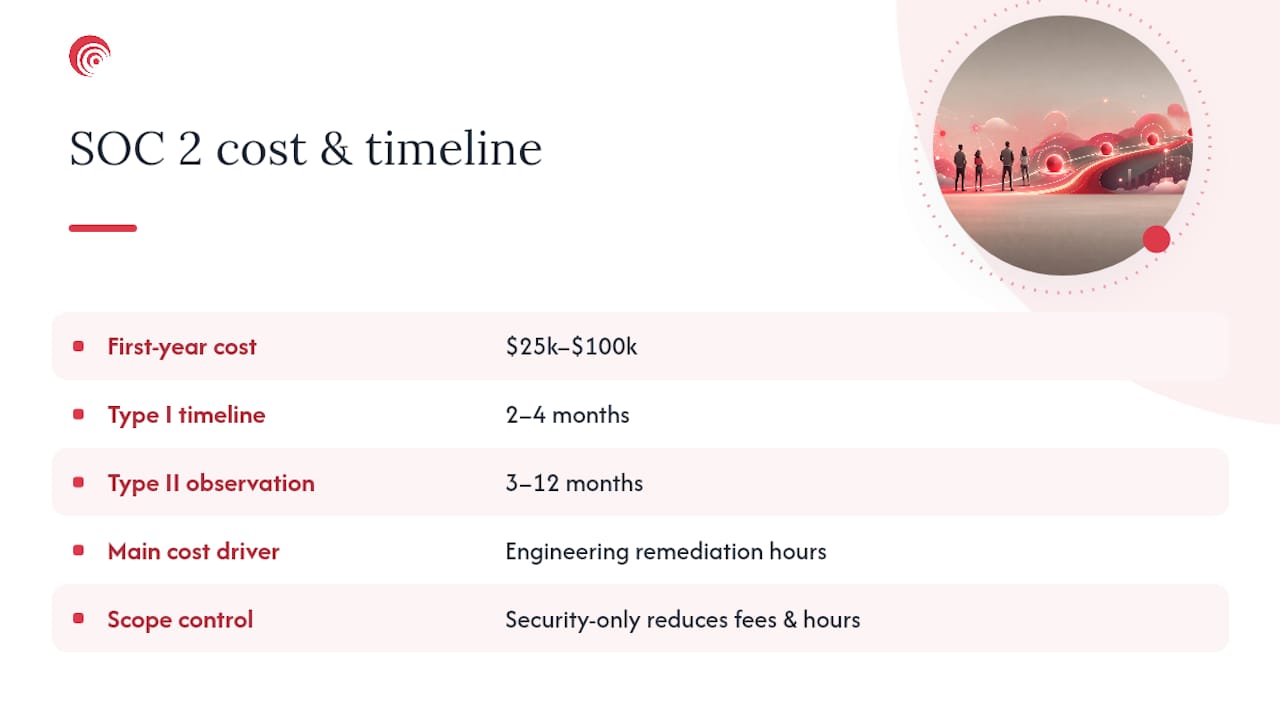
Budgets vary more by how much engineering remediation you need than by which auditor you pick. Independent industry analysis puts first-year, all-in Type II costs for small SaaS startups at roughly $25,000 to $100,000, and the engineering hours spent fixing gaps, not the audit fee itself, are usually the largest single cost.
Timeline runs in two phases. A Type I typically takes 2 to 4 months from kickoff to report, covering gap analysis, remediation, and a point-in-time audit. A Type II adds an observation window on top, commonly 3 to 12 months depending on how much assurance your buyers need, which means if you have a sales deadline six months out, you likely need to start now, not after the next big deal closes.
Controlling scope is the fastest lever on cost. Staying Security-only instead of adding Availability or Confidentiality can cut both audit fees and remediation hours meaningfully, since each added criterion multiplies the evidence you need to collect and defend.
Pro Tip: If your sales team promises a Type II report to a prospect "in three months," correct that expectation immediately. A rushed observation window is the single biggest reason startups end up delivering a weaker report than the deal required.
Running SOC 2 as an Ongoing Program, Not a One-Time Project
SOC 2 isn't a certificate you earn once and frame. Type II reports expire, and renewal means running through another observation window every year, which is why the smartest startups treat evidence collection as a permanent, lightweight habit rather than a quarterly fire drill.
Assign a named owner to each control category, access reviews, vendor management, incident response, and put evidence collection on a monthly or quarterly calendar rather than scrambling before the next audit. Compliance automation platforms genuinely cut the labor of gathering that evidence, but they don't fix a missing control for you; someone still has to close the gap the tool flags.
The exceptions that recur year over year are almost always the same three: log retention windows that quietly expired, employee access that never got revoked after a role change, and offboarding tickets that closed without confirming every system was actually locked down. Build a renewal checklist that specifically re-checks these three areas before every audit cycle.
Pro Tip: Put access reviews on a recurring calendar invite with the control owner's name attached, not a shared to-do list. The reviews that get skipped are almost always the ones with no individual owner.
How Marfi Helps Startups Get There Faster
Marfi runs managed IT, a 24/7 security operations center, and compliance operations for regulated and growth-stage companies, and holds its own SOC 2 Type II attestation. For startups without spare engineering capacity, that managed model absorbs the remediation work, MDM enrollment, centralized logging, access review cadence, that otherwise falls on your smallest team. It's the right fit once DIY or platform-assisted routes start competing with product roadmap time.
A Founder's Quick Checklist for the Next 90 Days
Start with a gap scan against Security criteria this month, then enforce MFA and SSO across every system before you touch anything else. If you have an enterprise deal on the table now, target Type I as your bridge report; if you have 6 or more months of runway before that deadline, skip straight to Type II and avoid paying for two separate audit engagements. Budget for this as a recurring line item, not a one-time project, and if your team has no spare engineering hours, get in front of a managed provider like Marfi's compliance operations team before you commit to a report deadline you can't hit.
— Daniel Mehditash, CISSP
Get SOC 2 Ready Without Pulling Engineers Off the Roadmap
Marfi is the alternative to hiring a compliance consultant and hoping your engineering team finds spare hours: one accountable team handles managed IT, 24/7 monitoring, and compliance operations under a single agreement, backed by Marfi's own SOC 2 Type II attestation.
Startups working with Marfi typically move faster because the MDM enrollment, access reviews, and centralized logging that usually stall a DIY effort are already built into the managed service, priced as a monthly subscription with scoped project work for initial remediation. Most engagements move from kickoff to audit-ready evidence within a few months, not the better part of a year. If your team is based in Los Angeles, Santa Monica, or anywhere in Southern California and you'd rather hand off the control work than build it internally, talk to Marfi's compliance operations team about scoping your first SOC 2 engagement.
Sources
For technical control design, NIST SP 1300 maps cybersecurity outcomes to measurable controls, and CISA's cybersecurity advisories detail the logging, patching, and monitoring practices auditors expect. Microsoft's documentation on Azure Monitor log retention and Intune device compliance settings covers the platform-specific settings most audits sample directly. For a plain-language breakdown of the Trust Services Criteria, SANS's overview remains one of the clearest available.
- NIST SP 1300: Mapping cybersecurity outcomes to measurable controls
- CISA cybersecurity advisory
- Configure data retention in Azure Monitor
- SANS: SOC 2 trust services categories explained
- What SOC 2 really costs a startup in 2026